
What Is a Pressure Transmitter? Meaning, Signal Output and Features of 0–1 Bar vs. 0–4 Bar Models
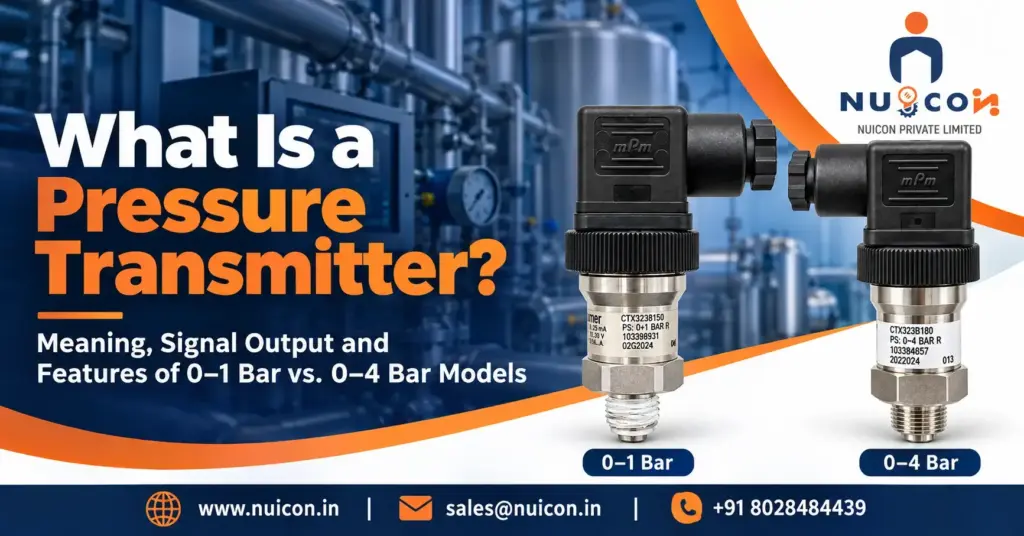
What Is a Pressure Transmitter? Meaning, Signal Output and Features of 0–1 Bar vs. 0–4 Bar Models Meaning:- A pressure transmitter measures pressure—the force per unit area exerted by a liquid or gas—and provides a conditioned electrical output for a PLC, computer or display. The Analog Analogy As a simple analogy, pressure changes the output smoothly, similar to adjusting a dimmer. The following examples assume a linear, zero-based 4–20 mA pressure scale; the transmitter does not directly drive a lamp. Zero pressure = 4 mA. This is a live zero: the loop carries current even at the lower measurement limit. Half-scale pressure = 12 mA: 0.5 bar on a 0–1 bar model, or 2 bar on a 0–4 bar model. Full-scale pressure = 20 mA: 1 bar on a 0–1 bar model, or 4 bar on a 0–4 bar model. Why is it called a “Transmitter” and not just a “Sensor”? A sensing element responds to pressure through an electrical or mechanical change. The terms sensor, transducer and transmitter overlap in commercial usage. A transmitter includes conditioning electronics and a specified output, such as 4–20 mA. Current loops support remote measurement within their voltage and resistance limits. Correct installation reduces interference, but no transmission method is immune to all noise or wiring faults. 0–1 Bar Pressure Transmitter Features A 0–1 bar model provides a 1 bar measuring span. Suitability depends on the required pressure type, accuracy and application conditions, rather than an assumed trade-off between sensitivity and strength. Sensing Construction: Metallic, ceramic and other sensing designs are available. Range alone does not determine diaphragm thickness or guarantee suitability for low-velocity air measurement. Signal Sensitivity: A linear 4–20 mA version provides 16 mA/bar. This gives four times the current change per bar of a 0–4 bar version. Actual resolution and accuracy remain product- and receiver-dependent. Overpressure Capability: Check the specified permissible overload and burst pressure. Do not assume a 2–3 bar limit from a 0–1 bar measuring range. Burst pressure is not an allowable operating pressure. Pressure Reference: A vented gauge model measures relative to local atmosphere; protect its reference arrangement as instructed. Absolute-pressure and other reference types differ. Atmospheric venting is not unique to the 0–1 bar range. 0–4 Bar Pressure Transmitter Features A 0–4 bar model provides a measuring span four times wider than a 0–1 bar model. It may suit regulated air, water or lubrication services within its specifications. Sensing Construction: Technology and mechanical durability depend on the product family. A thicker diaphragm or more robust sensing die cannot be assumed from the range alone. Measuring Span: A 0–4 bar model covers a 2–3 bar operating condition that is outside a 0–1 bar span. Allow for actual maximum pressure and transients when selecting the instrument. Overpressure Capability: Use manufacturer-specified limits rather than assuming an 8–12 bar proof rating. Confirm how the manufacturer defines overload, proof and burst pressure and any limits on exposure. Pulsation Protection: Check dynamic-pressure suitability. Water hammer and pump pulsations may require a specified snubber, damper or other protection. Internal fill fluid, where present, primarily transmits pressure to the sensing element. Comparison of Core Features Feature 0–1 Bar Transmitter 0–4 Bar Transmitter Primary Focus A 1 bar measuring span; ideal current sensitivity 16 mA/bar. A 4 bar measuring span; ideal current sensitivity 4 mA/bar. Burst Pressure Model-specific; verify the datasheet. Not a permissible operating limit. Model-specific; verify the datasheet. Not a permissible operating limit. Diaphragm Thickness Design-specific; cannot be inferred from range alone. Design-specific; cannot be inferred from range alone. Best Used For Suitable vented-tank level, test rigs or gas services; confirm range, accuracy and materials. Duct air usually requires a much lower range. Suitable regulated air branches, water circuits or lubrication lines within the specified range and ratings. Selection note: compare accuracy on the same basis. For illustration, ±0.5% of span equals ±0.005 bar on a 0–1 bar instrument and ±0.020 bar on a 0–4 bar instrument. These are examples, not specifications for a particular product. Recent Posts What Is a Pressure Transmitter? Meaning, Signal Output and Features of 0–1 Bar vs. 0–4 Bar Models October 24, 2026 How a 0–4 Bar Pressure Transmitter Works: Internal Components and Installation Materials The following describes common construction options and installation… Read More → How a Pressure Transmitter Works: Meaning, Uses, Benefits, Risks of Not Using One, and 0–1 Bar vs. 0–4 Bar Comparison. October 24, 2026 How a Pressure Transmitter Works: Meaning, Uses, Benefits, Risks of Not Using One, and 0–1 Bar vs. 0–4 Bar Comparison… Read More → How a 0–4 Bar Pressure Transmitter Works: Internal Components and Installation Materials October 24, 2026 How a 0–4 Bar Pressure Transmitter Works: Internal Components and Installation Materials The following describes common construction options and installation… Read More → How a 0–4 Bar Pressure Transmitter Works in Pneumatic Systems, Water Treatment, Heating and Cooling Loops, Lubrication and Low-Pressure Hydraulics October 24, 2026 How a 0–4 Bar Pressure Transmitter Works in Pneumatic Systems, Water Treatment, Heating and Cooling Loops, Lubrication and Low-Pressure Hydraulics… Read More → REQUEST A QUOTE
How a Pressure Transmitter Works: Meaning, Uses, Benefits, Risks of Not Using One, and 0–1 Bar vs. 0–4 Bar Comparison.

How a Pressure Transmitter Works: Meaning, Uses, Benefits, Risks of Not Using One, and 0–1 Bar vs. 0–4 Bar Comparison Meaning:- A pressure transmitter measures the pressure of a liquid or gas and converts it into a standardised electrical signal, such as 4–20 mA, for a controller or display. Pressure is force per unit area. Essentially, it acts as the “eyes” for a computer system, translating real-world pressure into data. Working principle:- A sensing assembly responds to applied pressure, and internal electronics convert its response into the specified current, voltage or digital output. Here is the step-by-step breakdown of how it works, followed by the differences between a 0–1 bar and a 0–4 bar transmitter. Step-by-Step Operation:- Pressure Application: The process fluid (liquid or gas) enters the transmitter’s inlet and presses against a flexible sensing diaphragm. Mechanical Deflection: The physical pressure causes the diaphragm to bend slightly. More pressure equals more deflection. Sensor Conversion: The diaphragm’s movement changes an electrical property in an internal sensor. This is usually done via a piezoresistive sensor (where resistance changes with strain) or a capacitive sensor (where the distance between two plates changes). Signal Conditioning: An internal circuit measures this micro-change in resistance or capacitance and converts it into a standardized linear electrical signal. Output Transmission: The transmitter sends this final signal (e.g., 4–20 mA) to a controller like a PLC or a digital display. Comparison: 0–1 Bar vs. 0–4 Bar Transmitters Both ranges may use the same sensing technology within a product family, but this is not guaranteed. The definite difference is the calibrated pressure span; construction, accuracy, resolution and overload limits require datasheet confirmation. Feature 0–1 Bar Transmitter 0–4 Bar Transmitter Pressure Range Measures low pressures from 0 to 1 bar (approx. 0 to 14.5 psi). Measures 0–4 bar, approximately 0–58 psi or 0–400 kPa. Diaphragm Design Depends on sensor technology and manufacturer; a thinner diaphragm cannot be assumed from the range alone. Depends on sensor technology and manufacturer; a thicker diaphragm cannot be assumed from the range alone. Electrical Scaling (4–20 mA example) • 4 mA = 0 bar • 12 mA = 0.5 bar • 20 mA = 1 bar • 4 mA = 0 bar • 12 mA = 2 bar • 20 mA = 4 bar Resolution & Sensitivity Ideal current sensitivity: 16 mA/bar. Actual resolution and accuracy depend on the transmitter and receiver. Ideal current sensitivity: 4 mA/bar. With otherwise identical electronics, percentage-of-span resolution may be similar, while resolution in bar differs. Overpressure Limit Use the model-specific permissible overload and burst-pressure values. Neither is established by the measuring span alone. Use the model-specific permissible overload and burst-pressure values. A wider span does not guarantee resistance to water hammer. Benefits and Risks of Pressure MonitoringPressure feedback can support remote indication, alarms, process control and troubleshooting. The consequences of inadequate monitoring depend on the process and other safeguards. Mechanical gauges, pressure switches and independent protective devices may also form part of the design. Financial and Operational Impacts Equipment Protection: Suitable monitoring can help identify abnormal pressure and initiate designed responses. A transmitter alone does not prevent pump damage, boiler overpressure or pipe failure; relief devices and other protection remain application-specific. Production Downtime: Unexpected pressure variations can disrupt production. Trends and configured alarms may help operators identify problems earlier, although financial impact varies by installation. Product Quality: Pressure control can improve consistency in processes such as dosing, packaging and mixing. The benefit depends on the process and the complete control loop. Safety and Compliance Risks Safety and Compliance: Pressure feedback may support a protective function only when the complete system is designed and validated for that purpose. The applicable requirements depend on the installation; a general-purpose transmitter is not automatically a safety-rated device. Operator Workload: Remote indication and logging can reduce routine manual readings and improve visibility, while local gauges and inspections may still be required. Energy Use: Appropriate pressure feedback can help pumps, compressors and HVAC equipment meet demand efficiently. Savings depend on control strategy and actual operating conditions. Recent Posts How a Pressure Transmitter Works: Meaning, Uses, Benefits, Risks of Not Using One, and 0–1 Bar vs. 0–4 Bar Comparison. October 24, 2026 How a 0–1 Bar Pressure Transmitter Works: Internal Components and Installation Materials The following describes common construction options and installation… Read More → How a 0–4 Bar Pressure Transmitter Works: Internal Components and Installation Materials October 24, 2026 How a 0–4 Bar Pressure Transmitter Works: Internal Components and Installation Materials The following describes common construction options and installation… Read More → How a 0–4 Bar Pressure Transmitter Works in Pneumatic Systems, Water Treatment, Heating and Cooling Loops, Lubrication and Low-Pressure Hydraulics October 24, 2026 How a 0–4 Bar Pressure Transmitter Works in Pneumatic Systems, Water Treatment, Heating and Cooling Loops, Lubrication and Low-Pressure Hydraulics… Read More → How a 0–1 Bar Pressure Transmitter Works: Internal Components and Installation Materials October 24, 2026 How a 0–1 Bar Pressure Transmitter Works: Internal Components and Installation Materials The following describes common construction options and installation… Read More → REQUEST A QUOTE