
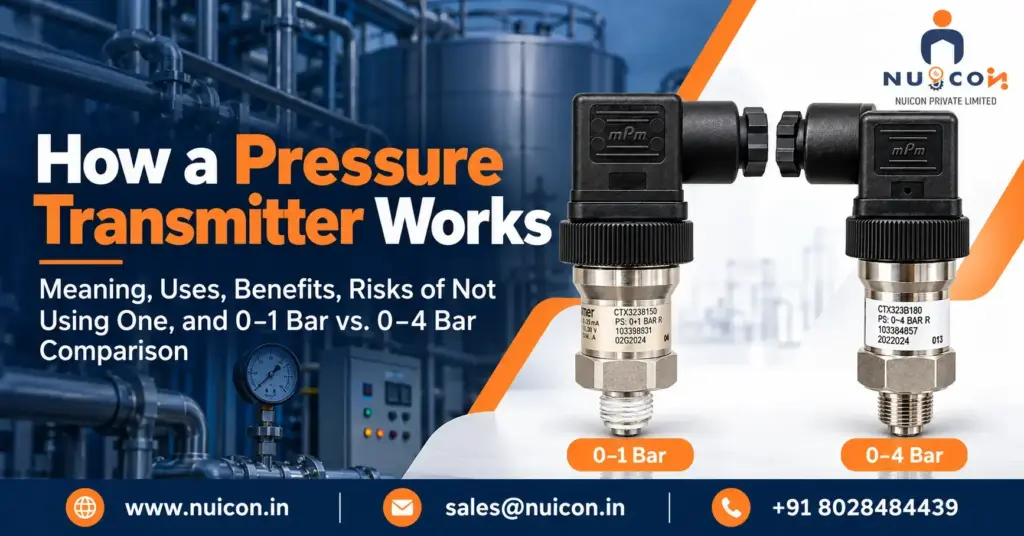
A pressure transmitter measures the pressure of a liquid or gas and converts it into a standardised electrical signal, such as 4–20 mA, for a controller or display. Pressure is force per unit area.
Essentially, it acts as the “eyes” for a computer system, translating real-world pressure into data.
A sensing assembly responds to applied pressure, and internal electronics convert its response into the specified current, voltage or digital output.
Here is the step-by-step breakdown of how it works, followed by the differences between a 0–1 bar and a 0–4 bar transmitter.
Both ranges may use the same sensing technology within a product family, but this is not guaranteed. The definite difference is the calibrated pressure span; construction, accuracy, resolution and overload limits require datasheet confirmation.
Feature | 0–1 Bar Transmitter | 0–4 Bar Transmitter |
Pressure Range | Measures low pressures from 0 to 1 bar (approx. 0 to 14.5 psi). | Measures 0–4 bar, approximately 0–58 psi or 0–400 kPa. |
Diaphragm Design | Depends on sensor technology and manufacturer; a thinner diaphragm cannot be assumed from the range alone. | Depends on sensor technology and manufacturer; a thicker diaphragm cannot be assumed from the range alone. |
Electrical Scaling (4–20 mA example) | • 4 mA = 0 bar • 12 mA = 0.5 bar • 20 mA = 1 bar | • 4 mA = 0 bar • 12 mA = 2 bar • 20 mA = 4 bar |
Resolution & Sensitivity | Ideal current sensitivity: 16 mA/bar. Actual resolution and accuracy depend on the transmitter and receiver. | Ideal current sensitivity: 4 mA/bar. With otherwise identical electronics, percentage-of-span resolution may be similar, while resolution in bar differs. |
Overpressure Limit | Use the model-specific permissible overload and burst-pressure values. Neither is established by the measuring span alone. | Use the model-specific permissible overload and burst-pressure values. A wider span does not guarantee resistance to water hammer. |
Benefits and Risks of Pressure Monitoring
Pressure feedback can support remote indication, alarms, process control and troubleshooting. The consequences of inadequate monitoring depend on the process and other safeguards. Mechanical gauges, pressure switches and independent protective devices may also form part of the design.
WhatsApp us