
Dial Thermometer Gauge: Reliable Local Temperature Checks
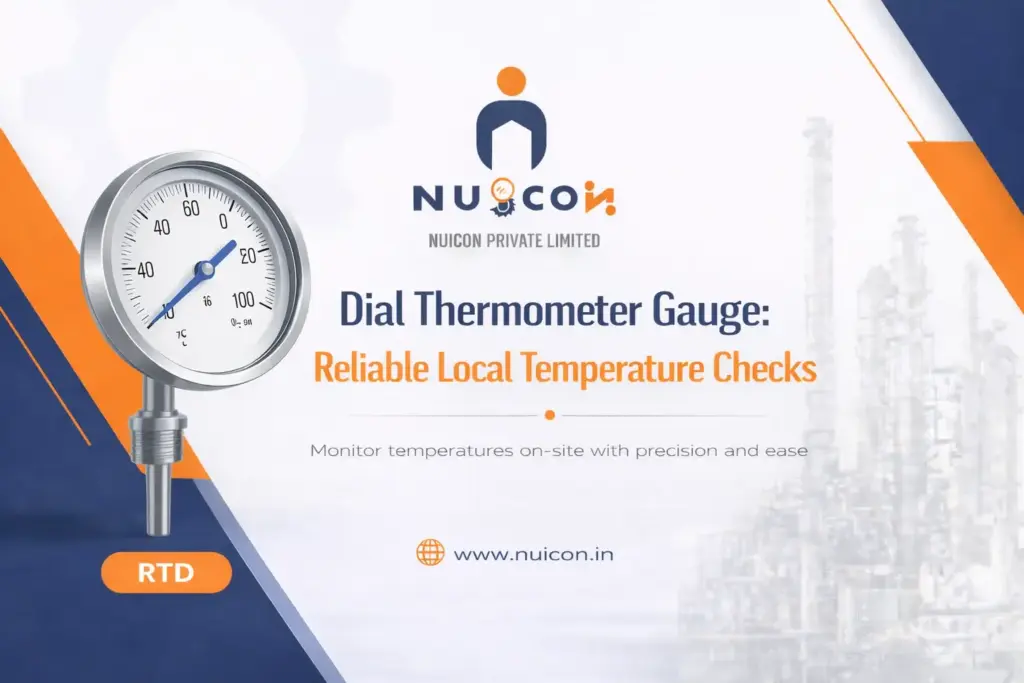
Dial Thermometer Gauge: Reliable Local Temperature Checks In an era of digital sensors and cloud-based data, the humble Dial Thermometer Gauge remains an indispensable tool for industrial safety. Why? Because when power fails or electronics glitch, a mechanical gauge continues to provide accurate, real-time temperature readings. For many plant operators, the ability to walk past a tank or boiler and instantly verify the temperature at a glance is the first line of defense against process failure. What is a Dial Thermometer Gauge? A Dial Thermometer Gauge is a mechanical instrument that converts thermal energy into the movement of a pointer across a calibrated scale. Unlike electronic sensors, these gauges require no external power source, making them ideal for remote locations, hazardous zones, and as redundant backup systems. The Nuicon Advantage: Bimetal vs. Gas-Filled At Nuicon, we manufacture two primary types of mechanical thermometers to suit different industrial needs: Bimetal Dial Thermometer: Uses a helical coil of two different metals that expands at different rates. It’s rugged, reliable, and the industry standard for general process monitoring. Gas-Filled Dial Thermometer: Utilizes the expansion of inert gas. These offer faster response times and are capable of measuring much wider temperature ranges with extreme long-term stability. Choosing the Right Configuration for Your Plant The environment dictates the design. To ensure your thermal monitoring is effective, you must choose a mounting style that fits your piping and visibility requirements. Every-Angle (Adjustable) Mounting: Our most popular design. It features a swivel joint so the dial can be tilted or rotated for easy reading, regardless of how the piping is installed. Capillary Dial Thermometer: When the sensing point is inside a high-heat zone or a cramped space, a capillary gauge allows the dial to be mounted up to several meters away for safe operator viewing. Back vs. Bottom Entry: Depending on whether your sensor is entering a tank from the side or a pipe from the top, choosing the correct entry point ensures the dial is always facing the operator. Industrial Heavy Duty: For environments with massive mechanical vibration—like large diesel engines or high-pressure compressors—we provide dampened movements to prevent pointer flutter. Why “Local Indication” Matters in Industrial Automation While a Temperature Transmitter sends data to your PLC, the Dial Thermometer Gauge serves the human element of the factory. Redundancy: If the control room loses signal, the local gauge ensures the onsite engineer still knows exactly what is happening inside the vessel. Safety in Hazardous Zones: Mechanical gauges are inherently “spark-free,” making them perfect for explosive environments where electronic devices would require expensive flameproof housings. No Maintenance: No batteries to change, no wires to pull, and no software to update. Just pure, mechanical reliability. Why Nuicon is the Preferred Choice for Gauges As a specialized manufacturer in Bangalore, Nuicon builds gauges that aren’t just accurate—they are built to survive. All-Stainless Steel Construction: We use SS304 or SS316 cases and stems as standard to prevent corrosion in chemical and outdoor environments. NABL Calibration: Every Dial Thermometer Gauge can be supplied with a NABL Calibration certificate, ensuring that your local readings match international accuracy standards. Custom Stem Lengths: Whether you need a 50mm stem for a small pipe or a 1000mm stem for a deep tank, we manufacture to your exact specifications. Hermetic Sealing: Our gauges are sealed to prevent fogging and moisture ingress, ensuring the dial remains crystal clear for years. Frequently Asked Questions Can a Dial Thermometer be calibrated? Yes. Most Nuicon bimetal thermometers feature an external reset screw on the back of the case, allowing for easy field calibration. Are these gauges safe for food and pharma? Absolutely. We offer mercury-free gas-filled models and bimetal versions with sanitary fittings that meet strict hygiene standards. Ready to Secure Your Local Monitoring? Don’t wait for an electronic failure to realize you need a backup. Equip your facility with Nuicon’s high-visibility, rugged Dial Thermometer Gauge solutions today. Recent Posts Industrial Thermowell: Protecting Your Temperature Sensors March 11, 2026 Industrial Thermowell: Protecting Your Temperature Sensors In high-pressure pipelines and corrosive chemical tanks, a temperature sensor is only as good… Read More → Dial Thermometer Gauge: Reliable Local Temperature Checks March 11, 2026 Dial Thermometer Gauge: Reliable Local Temperature Checks In an era of digital sensors and cloud-based data, the humble Dial Thermometer… Read More → Industrial Pressure Transmitter Selection Guide: Liquids, Gas & Steam March 10, 2026 Industrial Pressure Transmitter Selection Guide: Liquids, Gas & Steam The Quick Answer: Transducer vs. Transmitter Before buying, you must know… Read More → Pt100 Sensor Guide: Wiring, Working Principle & Applications March 10, 2026 Pt100 Sensor Guide: Wiring, Working Principle & Applications The Quick Answer: What is a Pt100 Sensor? A Pt100 sensor is… Read More →
Pt100 Sensor Guide: Wiring, Working Principle & Applications

Pt100 Sensor Guide: Wiring, Working Principle & Applications The Quick Answer: What is a Pt100 Sensor? A Pt100 sensor is the most common type of resistance temperature detector (RTD) used in industry. The name tells you exactly what it is: “Pt” stands for platinum (the material used). “100” stands for 100 ohms (the resistance value at 0°C). It is the global standard for applications requiring high temperature accuracy and stability between -200°C and +850°C. If your process needs precision better than 1°C, a Pt100 is likely your best choice. 1. Understanding the Working Principle The working principle of a Pt100 is based on the relationship between metal and temperature. As the temperature of the platinum element increases, its resistance to electricity increases in a predictable, linear way. Unlike thermocouples, which generate voltage, a Pt100 RTD is a passive device. To get a temperature reading, your controller or PLC sends a small electric current through the sensor to measure the resistance, then converts that resistance into a temperature display. Because Platinum is chemically inert and stable, these sensors offer excellent repeatability, meaning they will read the same temperature consistently over many years without significant drift. 2. Pt100 Wiring Configurations (2, 3, and 4-Wire) One of the most confusing aspects for technicians is the wiring. You will see Pt100s sold as 2-wire, 3-wire, or 4-wire models. The difference isn’t just about the number of cables—it is about accuracy. A. 2-Wire Pt100 (Lowest Accuracy) This is the simplest form. One wire connects to each end of the element. The Problem: The controller measures the resistance of the sensor plus the resistance of the lead wires. If your cables are long, this added resistance causes a “false high” temperature reading. Use Case: Only used for short distances or where high precision is not critical (e.g., simple HVAC). B. 3-Wire Pt100 (The Industrial Standard) This is the most common configuration in manufacturing. It adds a third wire to the circuit. The Solution: The controller uses the third wire to measure and subtract the resistance of the lead cables. This “compensation” removes the error caused by long cable runs. Use Case: Standard for process instrumentation in Pharma, Food, and Textiles. C. 4-Wire Pt100 (Highest Accuracy) This setup uses two wires to carry the current and two wires to measure the voltage drop across the sensor element. The Benefit: It eliminates all lead wire errors, regardless of cable length or quality. Use Case: Laboratory calibration standards and high-precision thermal mapping. Nuicon Tech Note: For 90% of industrial applications, we recommend the 3-wire Pt100. It offers the perfect balance of cost and accuracy. 3. Accuracy Classes: Class A vs. Class B All platinum resistance thermometers are not equal. Tolerance standards defined by IEC 60751 grade them: Class B: The standard industrial grade. Accuracy: ±0.30°C at 0°C. Best for: General monitoring (water tanks, ovens). Class A: The precision grade. Accuracy: ±0.15°C at 0°C. Best for: Critical control points (chemical reactors, milk pasteurization). Nuicon manufactures both grades, but we always advise checking your process tolerance before choosing to avoid paying for unnecessary precision. 4. Why Choose a Pt100 Over Other Sensors? While thermistors and thermocouples have their place, the Pt100 sensor dominates the market for three reasons: Linearity: The resistance change is very smooth across the temperature range, making it easy to calibrate. Stability: Platinum does not degrade quickly. A high-quality OEM sensor can last for years with minimal drift. Interchangeability: Since Pt100 is a global standard, you can swap a Nuicon Pt100 with any other brand’s controller without reprogramming the system. Frequently Asked Questions (FAQs) What is the difference between Pt100 and Pt1000? A Pt100 has a resistance of 100Ω at 0°C, while a Pt1000 has 1000Ω. The Pt1000 is often used in battery-powered devices because its higher resistance requires less current, saving battery life. How do I test if my Pt100 is working? You can use a multimeter. At room temperature (approx 20-25°C), the resistance should read between 107Ω and 110Ω. If it reads infinite (open circuit) or zero (short circuit), the sensor is faulty. Can I extend the cable of my Pt100? Yes, but you must use a proper shielded instrumentation cable. If you are using a 2-wire sensor, extending the cable will reduce accuracy. We recommend using a temperature transmitter if the distance exceeds 50 meters. Conclusion: The Backbone of Industrial Temperature Control Whether you are managing a boiler in a textile mill or a cold storage unit in a pharma plant, the Pt100 sensor is likely the backbone of your control system. Its ability to provide reliable, precise data ensures your operations run safely and efficiently. However, getting the right reading depends on selecting the right wiring configuration (2, 3, or 4-wire) and the correct accuracy class. Nuicon specializes in manufacturing custom industrial sensors tailored to your specific cable lengths, sheath materials, and connection heads. Need a replacement Pt100 or a custom assembly? Explore Nuicon’s Temperature Solutions or contact our team for a quote today. Pt100 Sensor Guide: Wiring, Working Principle & Accuracy | Nuicon What is a Pt100 sensor? Understand the working principle, the difference between 2, 3 & 4-wire configurations, and accuracy classes in this expert guide by Nuicon. Recent Posts Industrial Pressure Transmitter Selection Guide: Liquids, Gas & Steam March 10, 2026 Industrial Pressure Transmitter Selection Guide: Liquids, Gas & Steam The Quick Answer: Transducer vs. Transmitter Before buying, you must know… Read More → 5 Types of Flow Meters for Industrial Use & How to Choose – Copy – Copy – Copy March 10, 2026 5 Types of Flow Meters for Industrial Use & How to Choose The Quick Answer: Which Flow Meter Do You… Read More → 5 Types of Flow Meters for Industrial Use & How to Choose March 5, 2026 5 Types of Flow Meters for Industrial Use & How to Choose The Quick Answer: Which Flow Meter Do You… Read More → How to Select the Right Temperature Transmitter for Your Plant March 5, 2026 How
RTD vs Thermocouple: Which Sensor is Best for Your Industrial Application
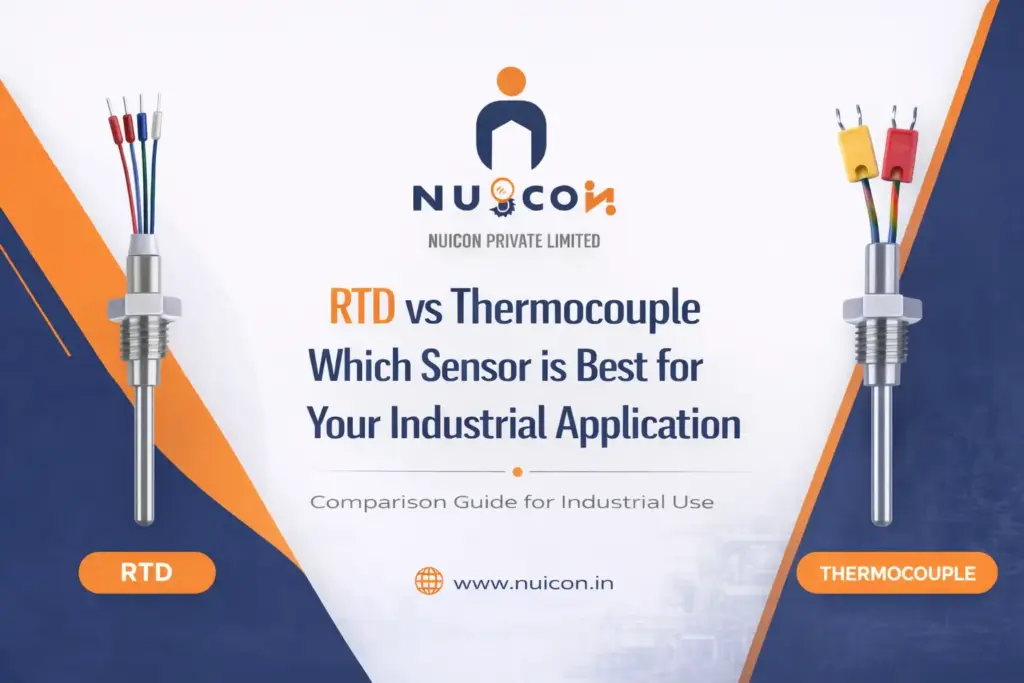
RTD vs Thermocouple: Which Sensor is Best for Your Industrial Application? The Quick Answer (For Busy Engineers – Plant Engineers, Facility Managers, OEMs.) If you need a fast decision on RTD vs Thermocouple, here is the rule of thumb: Select an RTD (Resistance Temperature Detector) if your priority is high accuracy and long-term stability within temperatures of -200°C to 850°C. They are the industry standard for Pharmaceuticals, Food & Beverage, and HVAC applications. Select a Thermocouple if your process involves extreme temperatures (up to 2300°C), heavy vibration, or requires a fast response time. They are the go-to choice for Steel, Cement Kilns, and Power Generation. Introduction: The Battle for Precision In industrial automation, temperature is the single most measured variable. Yet, selecting the right sensor remains one of the most common debates we hear from our clients at Nuicon. Choosing the wrong sensor isn’t just a technical detail—it impacts your bottom line. An incorrect choice can lead to energy wastage in boilers, inconsistent product quality in chemical batches, or frequent maintenance downtime. This guide provides a transparent, engineering-grade comparison of the RTD vs Thermocouple to help you make the right choice for your specific plant requirements in 2025. What is an RTD Sensor? An RTD (Resistance Temperature Detector) operates on a physical principle where the resistance of a metal increases as the temperature rises. Most industrial RTD sensors are constructed using high-purity Platinum. This is why you will often see them referred to as a Pt100 sensor (100 ohms at 0°C) or Pt1000. Platinum is chosen because it offers a highly linear and stable resistance-temperature relationship. Primary Benefit: exceptional repeatability and stability over time. Best For: Applications requiring precision control, such as a vaccine storage fridge or a milk pasteurization line. Nuicon Expert Tip: Because RTDs are sensitive, we often protect them with robust Thermowells to prevent physical damage from flow or pressure. What is a Thermocouple? A Thermocouple (TC) is a simpler, more rugged device. It consists of two dissimilar metal wires joined at one end, known as the “hot junction.” When this junction heats up, it generates a tiny voltage (millivolts) via the Seebeck Effect, which the controller reads as temperature. Unlike RTDs, thermocouple sensors are self-powered and do not require an external excitation current. Primary Benefit: Durability and wide temperature range. Common Types: Type J & K: Most common for general industrial use. Type R & S: Precious metals for very high heat. Best For: Harsh environments like blast furnaces, gas turbines, or engine exhausts. RTD vs Thermocouple: The Technical Comparison When designing an instrumentation system, comparing the specs side-by-side is critical. Here is how they stack up: Feature RTD (Resistance Temperature Detector) Thermocouple (TC) Temperature Range Moderate: -200°C to +850°C Extreme: -270°C to +2300°C Accuracy High: ±0.1°C (Class A) Lower: ±0.5°C to ±5.0°C Response Time Slower (2 to 10 seconds) Very Fast (Fraction of a second) Long-Term Drift Very Low (Stable for years) Higher (Needs frequent calibration) Vibration Handling Sensitive (Can fail under shock) Excellent (Handles high vibration) Cost Higher Initial Investment Lower Initial Cost Selection Guide: 4 Factors to Decide At Nuicon, we recommend evaluating these four factors before placing an order. A. Temperature Range This is your first filter. If your application exceeds 850°C—common in metal processing or brick manufacturing—an RTD will physically fail. In this range, a high-temperature thermocouple is your only option. B. Accuracy Requirements How tight is your tolerance? If a 1-degree shift affects your product quality (e.g., in a bio-reactor), the Pt100 sensor is the superior choice. Thermocouples have a wider “error margin” which might be unacceptable for precision chemistry. C. Response Time Does your temperature change rapidly? Because thermocouples measure at the tip (point contact), they react instantly. RTDs usually measure over a larger area (the element length), creating a slight lag. For plastic injection molding, where speed matters, go with a TC. D. Vibration and Environment If the installation point vibrates heavily (like a compressor or generator), the delicate wire construction of a standard RTD might break. A mineral-insulated thermocouple is built to withstand this abuse. Industry Use Cases: Where They Win Where RTD Wins: Pharmaceuticals: Precise temperature logging for compliance. Food & Beverage: Ensuring safety standards in brewing and dairy. HVAC Systems: Monitoring air ducts and chilled water lines for energy efficiency. Laboratories: Calibration standards and research. Where Thermocouple Wins: Steel & Cement: Kilns and ovens operating above 1000°C. Power Plants: Steam turbines and exhaust gas monitoring. Plastic Manufacturing: Extruders requiring fast thermal response. General OEM: Cost-effective sensors for simple machinery. Frequently Asked Questions (FAQs) Q: Can I replace a Thermocouple with an RTD? A: Not directly. Their electrical signals are different (Resistance vs. Voltage). To switch, you must ensure your temperature controller or PLC input card supports the new sensor type. Q: Why is the Pt100 the most common RTD? A: The Pt100 offers the best balance of linearity, cost, and stability. It has a resistance of 100 ohms at 0°C, making it a universal standard for industrial instrumentation. Q: How often should I calibrate my sensors? A: For critical industries like Pharma, we recommend sensor calibration every 6 to 12 months. Thermocouples generally drift faster than RTDs and may need more frequent checks. Conclusion: Precision or Durability? The debate of RTD vs Thermocouple isn’t about which technology is “better” overall—it is about which is better for your specific process. Need stability and precision? Choose an RTD. Need durability and high heat handling? Choose a Thermocouple. Nuicon manufactures both technologies in-house. Whether you need a custom-length Type K thermocouple or a sanitary Pt100 assembly, we deliver OEM-quality sensors tailored to your plant’s needs. Still unsure which sensor fits your machinery? Contact Nuicon’s Engineering Team today for a free consultation. Recent Posts RTD vs Thermocouple: Which Sensor is Best for Your Industrial Application September 19, 2025 RTD vs Thermocouple: Which Sensor is Best for Your Industrial Application? The Quick Answer (For Busy Engineers – Plant Engineers,… Read More →