
Rosemount 3051 Pressure Transmitter:- Full guide
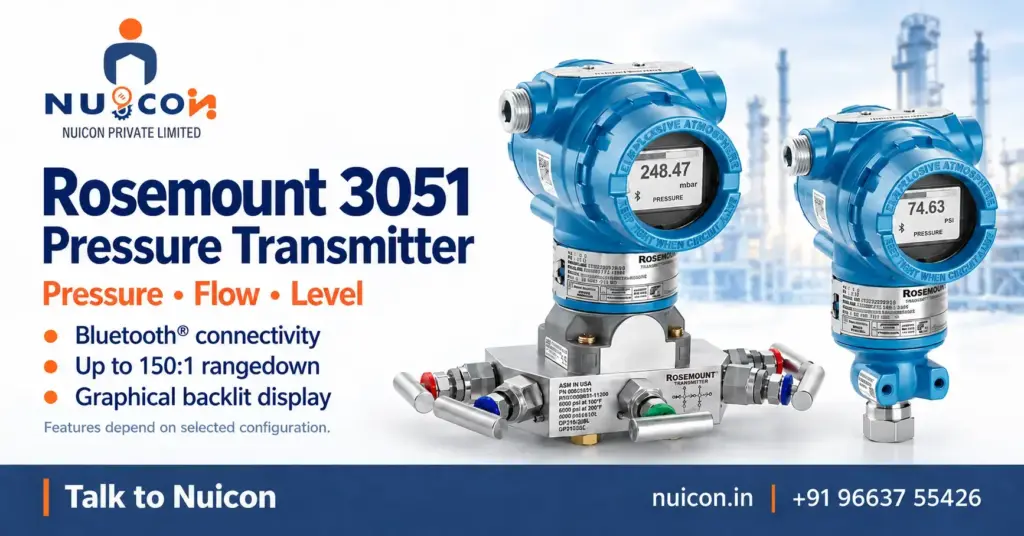
Rosemount 3051 Pressure Transmitter: Full Guide The Rosemount 3051 Pressure Transmitter is an established industrial measurement solution for monitoring pressure across demanding process environments. Depending on the selected configuration, it can measure differential, gauge and absolute pressure, while also supporting flow and level measurement applications. Its combination of measurement accuracy, long-term stability, diagnostic capabilities and communication flexibility makes it suitable for a wide range of process instrumentation requirements. With options such as Bluetooth®, HART®, WirelessHART®, FOUNDATION™ Fieldbus and PROFIBUS®, the transmitter can be integrated into different industrial control and monitoring systems. What Is the Rosemount 3051? A pressure transmitter measures pressure within a process and converts the measurement into a signal that can be used by control and monitoring systems. The Rosemount 3051 extends this function with flexible configurations, digital communication, diagnostics and field-access capabilities for industrial applications. How Does a Pressure Transmitter Work? Pressure Sensing The sensing element detects pressure changes from the connected process. Signal Processing Internal electronics process the sensor output and prepare the measurement for transmission. Data Communication The measured value is transmitted to connected control, monitoring or asset-management systems. Diagnostic Monitoring Available diagnostics provide additional information about selected device and process conditions. Key Features Up to 0.04% Accuracy Selected configurations provide up to 0.04% reference accuracy for demanding pressure measurement requirements. Up to 150:1 Rangedown Wide rangedown provides flexibility when measurement requirements vary across the process. Long-Term Stability Selected configurations are designed to provide up to 10 years of stability. Bluetooth® Connectivity Wireless connectivity allows convenient access to device information and configuration functions. Graphical Backlit Display The local display provides clear visibility of process measurements and transmitter information. Advanced Diagnostics Diagnostic capabilities help provide additional insight into process and device conditions. Flexible Communication Multiple communication options allow the transmitter to suit different industrial control architectures. Measurement Capabilities Differential Pressure Measures the difference between two process pressure points for monitoring, control, flow and level applications. Gauge Pressure Measures process pressure relative to atmospheric pressure. Absolute Pressure Measures pressure against an absolute vacuum reference. Flow Measurement Suitable configurations can support differential-pressure-based flow measurement. Level Measurement Pressure-based configurations can support level measurement in suitable process vessels and systems. Advanced Diagnostic Capabilities Plugged Impulse Line Detection Helps identify potential impulse-line blockage that could affect pressure measurement. Loop Integrity Provides information about electrical loop conditions that may influence signal performance. Process Alerts Helps highlight selected process or device conditions that require attention. Device Diagnostics Provides additional information that can assist with troubleshooting and maintenance activities. Communication & Connectivity 4–20 mA HART® Provides a widely used communication interface for industrial measurement and control systems. WirelessHART® Selected configurations can support wireless communication within suitable plant architectures. FOUNDATION™ Fieldbus Available configurations can support digital fieldbus-based instrumentation systems. PROFIBUS® Selected configurations provide compatibility with PROFIBUS® industrial communication networks. Bluetooth® Provides convenient wireless access for configuration and device interaction. Design & Configuration Coplanar™ Technology The Coplanar platform provides a flexible mounting approach for suitable pressure measurement installations. Flexible Configuration Different configurations allow the transmitter to be matched to measurement type, range and process requirements. Local Display A graphical backlit display provides convenient access to process and device information. Safety Options Selected configurations are available with SIL 2/3 certification options for applicable safety-related applications. Technical Specifications Specification Details Product Type Pressure Transmitter Measurement Types Differential, Gauge & Absolute Reference Accuracy Up to 0.04% Rangedown Up to 150:1 Stability Up to 10 years Communication 4–20 mA HART® Wireless Communication WirelessHART® options Digital Communication FOUNDATION™ Fieldbus & PROFIBUS® options Wireless Connectivity Bluetooth® Display Graphical Backlit Display Diagnostics Loop Integrity, Plugged Impulse Line & Process Alerts Applications Pressure, Flow & Level Safety Options SIL 2/3 configurations Mounting Coplanar™ and configuration-dependent options Pressure Range Configuration dependent Specifications may vary according to the selected model and configuration. Industrial Applications Oil & Gas Supports pressure measurement across production, processing and pipeline operations. Chemical Processing Suitable for monitoring pressure and process conditions in chemical manufacturing systems. Power Generation Supports pressure, flow and level measurement across power generation processes. Water & Wastewater Helps monitor pressure and process conditions in treatment and distribution systems. Pharmaceutical Processing Suitable for selected process and utility measurement applications. Process Manufacturing Supports pressure monitoring across automated production and processing operations. Pump & Pipeline Systems Helps monitor pressure conditions across pumps, pipelines and connected equipment. Flow Measurement Suitable configurations can support differential-pressure-based flow measurement systems. Benefits of the Rosemount 3051 Measurement Flexibility Multiple measurement types and configurations help accommodate different process requirements. Broad Communication Options Communication choices allow integration with different plant control and instrumentation systems. Useful Diagnostic Information Diagnostic functions provide additional information to support monitoring and troubleshooting. Convenient Field Access Bluetooth® connectivity and the graphical display can simplify device interaction. Long-Term Performance Extended stability specifications support applications requiring consistent measurement over time. How to Select the Right Configuration Identify the Measurement Type Determine whether the application requires differential, gauge or absolute pressure measurement. Define the Pressure Range Consider normal and maximum process pressure before selecting the appropriate measurement range. Review Process Conditions Evaluate process temperature, media compatibility, vibration and environmental conditions. Choose Communication Select the communication protocol required by the existing control or monitoring system. Consider Diagnostic Requirements Identify which diagnostic capabilities are relevant to the process and maintenance strategy. Check the Process Connection Confirm the required connection, materials and installation arrangement before ordering. Installation Considerations Select an Appropriate Location Choose an installation point that suits the process and environmental conditions. Plan Impulse Lines Carefully Proper impulse-line routing can help reduce measurement problems and maintenance requirements. Consider Temperature and Vibration Evaluate temperature variations and vibration at the proposed installation location. Provide Maintenance Access Position the transmitter where technicians can inspect and configure the device when required. Follow Product Requirements Installation and commissioning should follow the applicable product documentation and site procedures. Maintenance & Troubleshooting Check Diagnostic Information Review available diagnostic messages when unexpected measurements or alerts occur. Inspect Impulse Lines Check for potential blockage when abnormal pressure readings or diagnostic indications appear. Verify Configuration Review measurement range, output
Rosemount 4051S Pressure Transmitter:- Features, spec and applications
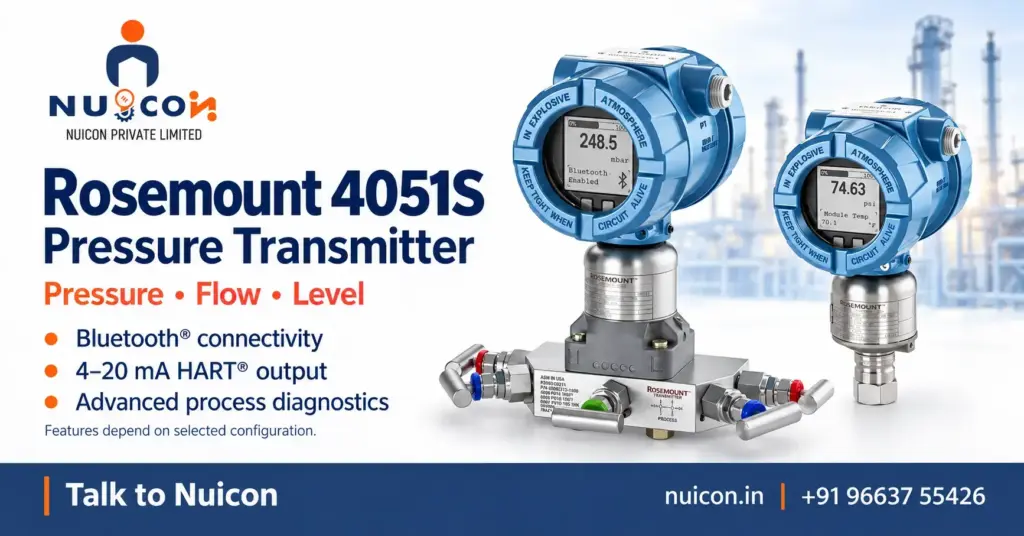
Rosemount 4051S Pressure Transmitter: Features, Specs & Applications The Rosemount 4051S Pressure Transmitter is designed for industrial processes where accurate and consistent pressure measurement is essential. Depending on the configuration, it can measure differential, gauge and absolute pressure, with options for flow and level applications. It combines measurement accuracy with wide rangedown, extended stability, intelligent diagnostics and digital connectivity. These capabilities make it suitable for process environments where reliable measurement and useful device information are important for operation, control and maintenance. What Is the Rosemount 4051S? A pressure transmitter measures process pressure and converts it into a signal that can be used by industrial control and monitoring systems. The Rosemount 4051S adds configurable measurement options, diagnostic functions and field connectivity to support modern process instrumentation requirements. How Does a Pressure Transmitter Work? Pressure Sensing The sensing element detects changes in pressure from the connected process. Signal Processing Internal electronics process the sensor signal and prepare it for industrial transmission. System Integration The measured value can be communicated to control, monitoring and asset-management systems. Diagnostic Monitoring Diagnostic functions provide additional information about selected process and device conditions. Key Features Up to 0.025% Accuracy Selected configurations provide up to 0.025% reference accuracy for demanding measurement applications. Up to 800:1 Rangedown Wide rangedown provides greater flexibility when measurement requirements change across the process. Up to 20-Year Stability Selected configurations are designed for extended measurement stability over long operating periods. Bluetooth® Connectivity Wireless connectivity provides convenient access for configuration and field device interaction. Graphical Backlit Display The local display makes process values and device information easier to view. 4–20 mA HART® Communication Provides a familiar communication interface for industrial control and instrumentation systems. Integral Relay Options Selected configurations can combine pressure measurement with relay-based switching functionality. Advanced Diagnostic Capabilities Process Intelligence Provides additional process information to help users understand changing operating conditions. Plugged Impulse Line Detection Helps identify potential impulse-line blockage that could affect pressure measurement. Loop Integrity Provides information about electrical loop conditions that may influence signal performance. Process Alerts Highlights selected process or device conditions that may require operator attention. Proof-Test Support Available proof-testing functions can assist with instrument verification and maintenance activities. Measurement Capabilities Differential Pressure Measures the pressure difference between two process points for applications such as flow and level measurement. Gauge Pressure Measures process pressure in relation to atmospheric pressure. Absolute Pressure Measures pressure against an absolute vacuum reference. Flow Measurement Specific configurations can support differential-pressure-based flow measurement. Level Measurement Suitable configurations can support pressure-based level measurement in process vessels and systems. Connectivity and Field Configuration 4–20 mA HART® Supports integration with established industrial measurement and control systems. Bluetooth® Provides wireless access to device information and configuration functions where supported. Local Display The graphical backlit display provides convenient access to process and device information. Design for Industrial Applications Hermetically Welded Sensor Platform The welded sensor construction is designed to support operation in demanding industrial environments. Pressure Protection The sensor architecture is designed to help manage the effects of pressure-related stresses on measurement performance. Flexible Configurations Multiple configurations allow the transmitter to be selected according to measurement type, range and application. Safety Options Selected configurations are available with SIL 2/3 certification options for applicable safety-related applications. Technical Specifications Specification Details Product Type Pressure Transmitter Measurement Types Differential, Gauge & Absolute Reference Accuracy Up to 0.025% Rangedown Up to 800:1 Stability Up to 20 years Communication 4–20 mA HART® Wireless Connectivity Bluetooth® Display Graphical Backlit Display Diagnostics Process Intelligence, Loop Integrity, Plugged Impulse Line & Process Alerts Relay Function Available on selected configurations Applications Pressure, Flow & Level Proof Testing Available Safety Options SIL 2/3 configurations Pressure Range Configuration dependent Specifications may vary according to the selected model and configuration. Pressure Range and Configuration Selecting the appropriate pressure range is important for achieving the required measurement performance. Differential and Gauge Pressure Selected Coplanar configurations support differential and gauge pressure measurement up to 2,000 psi (137.9 bar). Absolute Pressure Selected Coplanar configurations support absolute pressure measurement up to 4,000 psia (275.8 bar). Higher-Pressure Measurement Selected In-Line configurations can support gauge and absolute pressure measurement up to 10,000 psi. The appropriate range and configuration should be selected according to the actual process conditions. Industrial Applications Oil & Gas Supports pressure monitoring across production, processing and pipeline systems. Chemical Processing Suitable for pressure measurement across demanding chemical process operations. Power Generation Supports pressure, flow and level measurement across power-related processes. Water & Wastewater Helps monitor pressure and process conditions across treatment and distribution systems. Pharmaceutical Processing Suitable for selected process and utility measurement requirements. Process Manufacturing Supports pressure monitoring across automated production and processing operations. Pump and Pipeline Systems Helps track pressure conditions across pumping systems and connected pipelines. Flow Measurement Selected configurations can support differential-pressure-based flow measurement systems. Benefits of the 4051S Measurement Flexibility Wide rangedown and multiple measurement options help accommodate different process requirements. Additional Process Information Diagnostic functions provide useful information beyond the primary pressure reading. Convenient Field Access Bluetooth® connectivity can simplify device access during configuration and maintenance. Long-Term Measurement Capability Extended stability specifications support applications requiring sustained measurement performance. Flexible System Integration Communication and configuration options allow the transmitter to fit different instrumentation architectures. How to Select the Right Configuration Identify the Measurement Type Determine whether the application requires differential, gauge or absolute pressure measurement. Define the Pressure Range Consider normal, minimum and maximum process pressures before selecting the appropriate range. Check Process Conditions Review process temperature, media compatibility, vibration and environmental conditions. Select Communication Choose the communication method required by the control and monitoring system. Consider Diagnostic Requirements Identify the diagnostic functions that are relevant to the process and maintenance strategy. Review the Process Connection Confirm the required connection, materials and installation arrangement before ordering. Installation Considerations Choose the Installation Location Select a location appropriate for the process, environmental and operating conditions. Plan Impulse Lines Properly Good impulse-line routing can help minimise measurement issues and maintenance requirements. Consider Temperature and Vibration Evaluate temperature variation and vibration when
5 Types of Flow Meters for Industrial Use & How to Choose

5 Types of Flow Meters for Industrial Use & How to Choose The Quick Answer: Which Flow Meter Do You Need? If you are looking for a quick recommendation on types of flow meters, here is the industry cheat sheet: Electromagnetic (Magmeter): Best for water and wastewater. (Must be a conductive liquid). Ultrasonic Flow Meter: Best for non-intrusive measurement (clamp-on) or large pipes where cutting is difficult. Vortex Flow Meter: Best for steam and gas applications. Coriolis Mass Flow Meter: Best for high accuracy and measuring mass (kg) instead of volume (liters). Ideal for chemical dosing. Turbine Flow Meter: Best for clean, low-viscosity fuels like diesel or petrol. Introduction: Measuring the Pulse of Your Plant In any industrial plant, liquid and gas flow is like the blood in the veins. Whether you are managing a water treatment plant (STP/ETP), a chemical refinery, or a food processing line, knowing exactly how much fluid is moving is critical for efficiency and billing. But with so many industrial flow meter technologies available, how do you choose? A meter designed for clean water will fail instantly in sludge, and a meter meant for oil won’t work on steam. This guide breaks down the top 5 technologies we supply at Nuicon to help you select the right tool for the job. 1. Electromagnetic (Magmeter) The magnetic flow meter is the workhorse of the water industry. It works on Faraday’s Law of Induction: as a conductive fluid flows through a magnetic field, it generates a voltage. How it works: There are no moving parts. Sensors on the pipe wall measure the induced voltage. Best Application: Effluent Treatment Plants (ETP), Sewage, Potable Water, and Slurries. Limitations: The fluid must be conductive. It cannot measure oil or pure distilled water. Nuicon Insight: Because they have an open bore (no obstruction), Magmeters experience zero pressure drop and don’t clog, making them perfect for dirty water. 2. Ultrasonic Flow Meters These meters use sound waves to determine flow velocity. They come in two main types: Transit Time (for clean liquids) and Doppler (for dirty liquids). How it works: Transducers send ultrasonic pulses upstream and downstream. The difference in time it takes to travel determines the flow rate. Best Application: Large pipelines, district cooling, or temporary audits where you don’t want to cut the pipe. Key Benefit: Clamp-on ultrasonic flow meters can be installed on the outside of the pipe while the plant is running. 3. Vortex Flow Meters When a fluid flows past an obstacle (a “bluff body”), it creates alternating vortices (swirls). Think of a flag flapping in the wind. A vortex flow meter counts these swirls to calculate flow. How it works: A sensor detects the frequency of the vortices shedding off the bluff body. Best Application: Steam measurement in boilers, compressed air, and gases. Limitations: Not suitable for low flow rates (the vortices stop forming) 4. Coriolis Mass Flow Meters The Coriolis meter is the “Ferrari” of flow measurement. Unlike other meters that measure volume (liters/min), this measures mass flow (kg/min) directly. How it works: Fluid flows through vibrating tubes. The inertia of the fluid causes the tubes to twist. The degree of twist is proportional to the mass flow. Best Application: Custody transfer (billing), expensive chemicals, and mixing applications in Pharma and Food & Beverage. Key Benefit: Extremely accurate (±0.1%) and measures density/temperature simultaneously. 5. Turbine Flow Meters A classic mechanical solution. A turbine flow meter has a rotor (propeller) inside the pipe. The faster the fluid moves, the faster the rotor spins. How it works: A pickup sensor counts the blade passes to determine velocity. Best Application: Clean, low-viscosity liquids like Diesel, Petrol, and Solvents. Limitations: Moving parts mean bearings can wear out. Not good for dirty liquids containing debris. Comparison Table: At a Glance Flow Meter Type Fluid Type Accuracy Pressure Drop Cost Magnetic Conductive Liquids (Water) High None Medium Ultrasonic Clean or Dirty Liquids Medium None Medium/High Vortex Steam, Gas, Low Viscosity Liquid Medium Medium Medium Coriolis Liquids & Gases (High Value) Very High High High Turbine Clean Fuel/Solvents High High Low Conclusion: Match the Meter to the Medium Selecting the right types of flow meters usually comes down to three questions: Is the fluid conductive? (If yes $rightarrow$ Magmeter). Is it Steam or Gas? (If yes $rightarrow$ Vortex). Do you need extreme accuracy? (If yes $rightarrow$ Coriolis). Need help sizing a flow meter?Browse our Flow Instrumentation Range or contact our application engineers for a free recommendation. Recent Posts How to Choose the Best Coating Thickness Gauge for Metals (2025) – Copy – Copy March 5, 2026 How to Choose the Best Coating Thickness Gauge for Metals (2025) Product: Coating Thickness Gauge For Whom: Quality Control Inspectors,… Read More → How to Choose the Best Coating Thickness Gauge for Metals (2025) March 3, 2026 How to Choose the Best Coating Thickness Gauge for Metals (2025) Product: Coating Thickness Gauge For Whom: Quality Control Inspectors,… Read More → Top 5 HVAC Sensors for Energy Efficiency in Smart Buildings March 3, 2026 Top 5 HVAC Sensors for Energy Efficiency in Smart Buildings The Quick Answer: Which Sensors Save Money? If you want… Read More → RTD vs Thermocouple: Which Sensor is Best for Your Industrial Application September 19, 2025 RTD vs Thermocouple: Which Sensor is Best for Your Industrial Application? The Quick Answer (For Busy Engineers – Plant Engineers,… Read More →
How to Choose the Best Coating Thickness Gauge for Metals (2025)

How to Choose the Best Coating Thickness Gauge for Metals (2025) Product: Coating Thickness Gauge For Whom: Quality Control Inspectors, Automotive Detailers, Paint Shop Managers. Category: Sensors / Testing Instruments. The Quick Answer: Which Gauge Do You Need? If you need to measure paint or plating thickness on metal, the choice depends on the “substrate” (the metal underneath): Ferrous (F) Probe: Use this for magnetic metals (Steel, Iron). Ideally suited for structural steel, pipelines, and car bodies. Non-Ferrous (N) Probe: Use this for non-magnetic metals (Aluminum, Copper, Brass). Best for anodized aluminum or high-end automotive parts. Dual (FN) Probe: The best all-rounder. It automatically detects the metal type and switches modes. Recommendation: For most industrial professionals, a Dual (FN) Coating Thickness Gauge like the Nuicon EC-770 is the smartest investment because it handles both steel and aluminum surfaces without changing probes. Introduction: Quality Control Starts Here In industries like automotive, aerospace, and heavy engineering, paint isn’t just about looks—it’s about protection. Too thin, and the metal rusts. Too thick, and the paint cracks or wastes money. To ensure consistency, Quality Assurance (QA) teams rely on a Coating Thickness Gauge (also known as a DFT Meter or Paint Meter). These handheld devices measure the layer of dry film without damaging the part (Non-Destructive Testing). But with different testing principles like Magnetic Induction and Eddy Current, choosing the right tool can be confusing. This guide simplifies the technology to help you buy the right instrument. 1. Ferrous vs. Non-Ferrous: Knowing the Difference The most critical factor in selecting a gauge is the base material. Magnetic Induction (F Type) Principle: Uses a magnetic field to measure the distance between the probe tip and the magnetic metal substrate. Applications: Measuring paint, enamel, chrome, or galvanizing on Steel or Iron. Nuicon Series: EC-500A (F-Type). Eddy Current (N Type) Principle: Uses high-frequency alternating current to generate eddy currents in the substrate. Applications: Measuring anodizing, paint, or powder coating on Aluminum, Copper, or Brass. Nuicon Series: EC-770 (N-Type). Nuicon Expert Tip: If you run a job shop handling various parts, do not buy single-function gauges. A combined FN gauge saves time and prevents errors. 2. Key Features to Look For When comparing digital thickness meters, look beyond the price tag. These features determine usability in the field: V-Groove Probe: Essential for measuring on curved surfaces like pipes or rods. A flat probe will wobble and give inaccurate readings on a round pipe. Resolution: For standard paint jobs, 1 micron (1μm) resolution is fine. For thin coatings like chrome plating, you need 0.1μm precision. Zero Calibration: Every gauge drifts over time. Ensure your kit comes with calibration foils and zero plates (a piece of bare steel/aluminum) so you can reset the accuracy daily. 3. Top Industrial Applications Who actually uses these tools? Automotive Industry: Used to detect repainted panels on used cars (which indicates accidents) and to ensure factory paint consistency. Powder Coating: Ensuring the powder is thick enough to cure properly but not so thick that it peels. Pipeline Construction: Measuring anti-corrosion coatings on oil and gas pipes is a critical safety requirement. Galvanizing Plants: Verifying the thickness of zinc plating on steel structures. 4. How to Use a Coating Thickness Gauge Correctly Even the best coating thickness gauge will fail if used incorrectly. Follow these 3 steps for accurate results: Calibrate: Always perform a “Zero” check on the bare metal before starting. Perpendicular: Press the probe flat and straight down onto the surface. Do not drag it or tilt it. Average: Don’t rely on one spot. Take 3-5 readings across the surface and calculate the average to account for uneven paint application. Frequently Asked Questions (FAQs) Q: Can I measure paint on plastic or wood? A: No. These gauges require a metal substrate (magnetic or conductive) to work. To measure paint on plastic, you would need an ultrasonic gauge, which uses a different and more expensive technology. Q: What is the difference between Mils and Microns? A: These are just units of measurement. In the US, “Mils” (1/1000th of an inch) is common. In India and Europe, we use “Microns” (μm). The Nuicon EC Series allows you to switch between units with one button press. (1 Mil ≈ 25.4 Microns). Q: How often should I calibrate the gauge? A: We recommend doing a “Zero Calibration” using the bare metal plate provided in the kit before every shift or whenever you switch to a different base metal material. Conclusion: Precision is Protection Whether you are inspecting a brand new luxury car or checking the galvanization on a bridge beam, the right Coating Thickness Gauge is your first line of defense against corrosion and quality failure. At Nuicon, we supply the EC Series, a rugged line of industrial gauges designed for Indian manufacturing conditions—dust-proof, durable, and highly accurate. Ready to upgrade your QC kit? Check the Price of Nuicon EC-770 or contact us for a demo. Recent Posts How to Choose the Best Coating Thickness Gauge for Metals (2025) March 3, 2026 How to Choose the Best Coating Thickness Gauge for Metals (2025) Product: Coating Thickness Gauge For Whom: Quality Control Inspectors,… Read More → RTD vs Thermocouple: Which Sensor is Best for Your Industrial Application September 19, 2025 RTD vs Thermocouple: Which Sensor is Best for Your Industrial Application? The Quick Answer (For Busy Engineers – Plant Engineers,… Read More →