
Dial Thermometer Gauge: Reliable Local Temperature Checks
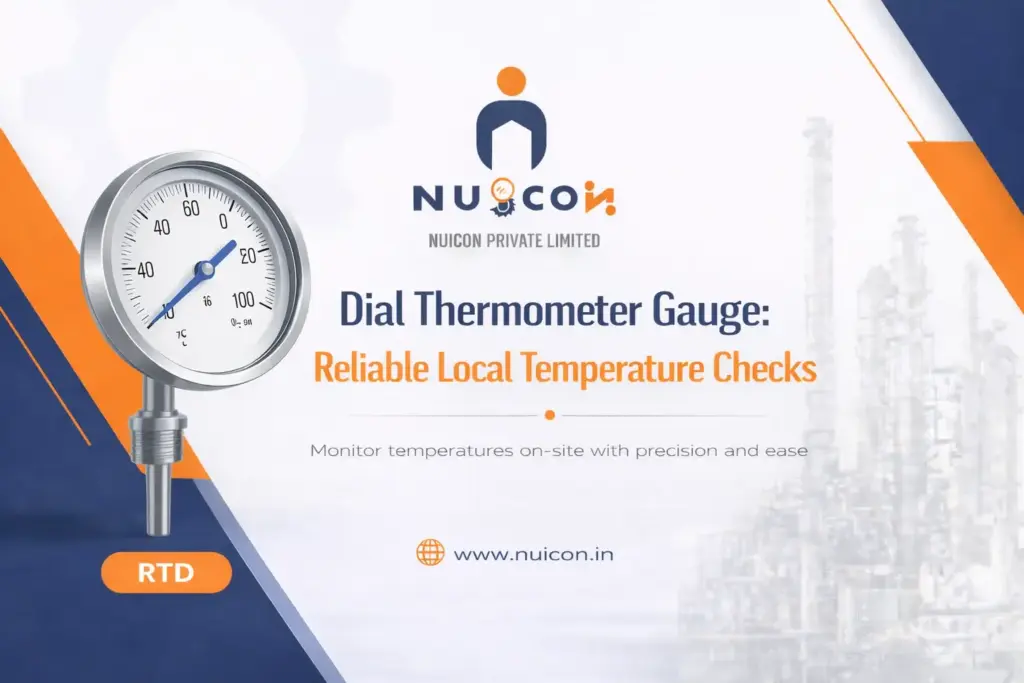
Dial Thermometer Gauge: Reliable Local Temperature Checks In an era of digital sensors and cloud-based data, the humble Dial Thermometer Gauge remains an indispensable tool for industrial safety. Why? Because when power fails or electronics glitch, a mechanical gauge continues to provide accurate, real-time temperature readings. For many plant operators, the ability to walk past a tank or boiler and instantly verify the temperature at a glance is the first line of defense against process failure. What is a Dial Thermometer Gauge? A Dial Thermometer Gauge is a mechanical instrument that converts thermal energy into the movement of a pointer across a calibrated scale. Unlike electronic sensors, these gauges require no external power source, making them ideal for remote locations, hazardous zones, and as redundant backup systems. The Nuicon Advantage: Bimetal vs. Gas-Filled At Nuicon, we manufacture two primary types of mechanical thermometers to suit different industrial needs: Bimetal Dial Thermometer: Uses a helical coil of two different metals that expands at different rates. It’s rugged, reliable, and the industry standard for general process monitoring. Gas-Filled Dial Thermometer: Utilizes the expansion of inert gas. These offer faster response times and are capable of measuring much wider temperature ranges with extreme long-term stability. Choosing the Right Configuration for Your Plant The environment dictates the design. To ensure your thermal monitoring is effective, you must choose a mounting style that fits your piping and visibility requirements. Every-Angle (Adjustable) Mounting: Our most popular design. It features a swivel joint so the dial can be tilted or rotated for easy reading, regardless of how the piping is installed. Capillary Dial Thermometer: When the sensing point is inside a high-heat zone or a cramped space, a capillary gauge allows the dial to be mounted up to several meters away for safe operator viewing. Back vs. Bottom Entry: Depending on whether your sensor is entering a tank from the side or a pipe from the top, choosing the correct entry point ensures the dial is always facing the operator. Industrial Heavy Duty: For environments with massive mechanical vibration—like large diesel engines or high-pressure compressors—we provide dampened movements to prevent pointer flutter. Why “Local Indication” Matters in Industrial Automation While a Temperature Transmitter sends data to your PLC, the Dial Thermometer Gauge serves the human element of the factory. Redundancy: If the control room loses signal, the local gauge ensures the onsite engineer still knows exactly what is happening inside the vessel. Safety in Hazardous Zones: Mechanical gauges are inherently “spark-free,” making them perfect for explosive environments where electronic devices would require expensive flameproof housings. No Maintenance: No batteries to change, no wires to pull, and no software to update. Just pure, mechanical reliability. Why Nuicon is the Preferred Choice for Gauges As a specialized manufacturer in Bangalore, Nuicon builds gauges that aren’t just accurate—they are built to survive. All-Stainless Steel Construction: We use SS304 or SS316 cases and stems as standard to prevent corrosion in chemical and outdoor environments. NABL Calibration: Every Dial Thermometer Gauge can be supplied with a NABL Calibration certificate, ensuring that your local readings match international accuracy standards. Custom Stem Lengths: Whether you need a 50mm stem for a small pipe or a 1000mm stem for a deep tank, we manufacture to your exact specifications. Hermetic Sealing: Our gauges are sealed to prevent fogging and moisture ingress, ensuring the dial remains crystal clear for years. Frequently Asked Questions Can a Dial Thermometer be calibrated? Yes. Most Nuicon bimetal thermometers feature an external reset screw on the back of the case, allowing for easy field calibration. Are these gauges safe for food and pharma? Absolutely. We offer mercury-free gas-filled models and bimetal versions with sanitary fittings that meet strict hygiene standards. Ready to Secure Your Local Monitoring? Don’t wait for an electronic failure to realize you need a backup. Equip your facility with Nuicon’s high-visibility, rugged Dial Thermometer Gauge solutions today. Recent Posts Industrial Thermowell: Protecting Your Temperature Sensors March 11, 2026 Industrial Thermowell: Protecting Your Temperature Sensors In high-pressure pipelines and corrosive chemical tanks, a temperature sensor is only as good… Read More → Dial Thermometer Gauge: Reliable Local Temperature Checks March 11, 2026 Dial Thermometer Gauge: Reliable Local Temperature Checks In an era of digital sensors and cloud-based data, the humble Dial Thermometer… Read More → Industrial Pressure Transmitter Selection Guide: Liquids, Gas & Steam March 10, 2026 Industrial Pressure Transmitter Selection Guide: Liquids, Gas & Steam The Quick Answer: Transducer vs. Transmitter Before buying, you must know… Read More → Pt100 Sensor Guide: Wiring, Working Principle & Applications March 10, 2026 Pt100 Sensor Guide: Wiring, Working Principle & Applications The Quick Answer: What is a Pt100 Sensor? A Pt100 sensor is… Read More →
Pt100 Sensor Guide: Wiring, Working Principle & Applications

Pt100 Sensor Guide: Wiring, Working Principle & Applications The Quick Answer: What is a Pt100 Sensor? A Pt100 sensor is the most common type of resistance temperature detector (RTD) used in industry. The name tells you exactly what it is: “Pt” stands for platinum (the material used). “100” stands for 100 ohms (the resistance value at 0°C). It is the global standard for applications requiring high temperature accuracy and stability between -200°C and +850°C. If your process needs precision better than 1°C, a Pt100 is likely your best choice. 1. Understanding the Working Principle The working principle of a Pt100 is based on the relationship between metal and temperature. As the temperature of the platinum element increases, its resistance to electricity increases in a predictable, linear way. Unlike thermocouples, which generate voltage, a Pt100 RTD is a passive device. To get a temperature reading, your controller or PLC sends a small electric current through the sensor to measure the resistance, then converts that resistance into a temperature display. Because Platinum is chemically inert and stable, these sensors offer excellent repeatability, meaning they will read the same temperature consistently over many years without significant drift. 2. Pt100 Wiring Configurations (2, 3, and 4-Wire) One of the most confusing aspects for technicians is the wiring. You will see Pt100s sold as 2-wire, 3-wire, or 4-wire models. The difference isn’t just about the number of cables—it is about accuracy. A. 2-Wire Pt100 (Lowest Accuracy) This is the simplest form. One wire connects to each end of the element. The Problem: The controller measures the resistance of the sensor plus the resistance of the lead wires. If your cables are long, this added resistance causes a “false high” temperature reading. Use Case: Only used for short distances or where high precision is not critical (e.g., simple HVAC). B. 3-Wire Pt100 (The Industrial Standard) This is the most common configuration in manufacturing. It adds a third wire to the circuit. The Solution: The controller uses the third wire to measure and subtract the resistance of the lead cables. This “compensation” removes the error caused by long cable runs. Use Case: Standard for process instrumentation in Pharma, Food, and Textiles. C. 4-Wire Pt100 (Highest Accuracy) This setup uses two wires to carry the current and two wires to measure the voltage drop across the sensor element. The Benefit: It eliminates all lead wire errors, regardless of cable length or quality. Use Case: Laboratory calibration standards and high-precision thermal mapping. Nuicon Tech Note: For 90% of industrial applications, we recommend the 3-wire Pt100. It offers the perfect balance of cost and accuracy. 3. Accuracy Classes: Class A vs. Class B All platinum resistance thermometers are not equal. Tolerance standards defined by IEC 60751 grade them: Class B: The standard industrial grade. Accuracy: ±0.30°C at 0°C. Best for: General monitoring (water tanks, ovens). Class A: The precision grade. Accuracy: ±0.15°C at 0°C. Best for: Critical control points (chemical reactors, milk pasteurization). Nuicon manufactures both grades, but we always advise checking your process tolerance before choosing to avoid paying for unnecessary precision. 4. Why Choose a Pt100 Over Other Sensors? While thermistors and thermocouples have their place, the Pt100 sensor dominates the market for three reasons: Linearity: The resistance change is very smooth across the temperature range, making it easy to calibrate. Stability: Platinum does not degrade quickly. A high-quality OEM sensor can last for years with minimal drift. Interchangeability: Since Pt100 is a global standard, you can swap a Nuicon Pt100 with any other brand’s controller without reprogramming the system. Frequently Asked Questions (FAQs) What is the difference between Pt100 and Pt1000? A Pt100 has a resistance of 100Ω at 0°C, while a Pt1000 has 1000Ω. The Pt1000 is often used in battery-powered devices because its higher resistance requires less current, saving battery life. How do I test if my Pt100 is working? You can use a multimeter. At room temperature (approx 20-25°C), the resistance should read between 107Ω and 110Ω. If it reads infinite (open circuit) or zero (short circuit), the sensor is faulty. Can I extend the cable of my Pt100? Yes, but you must use a proper shielded instrumentation cable. If you are using a 2-wire sensor, extending the cable will reduce accuracy. We recommend using a temperature transmitter if the distance exceeds 50 meters. Conclusion: The Backbone of Industrial Temperature Control Whether you are managing a boiler in a textile mill or a cold storage unit in a pharma plant, the Pt100 sensor is likely the backbone of your control system. Its ability to provide reliable, precise data ensures your operations run safely and efficiently. However, getting the right reading depends on selecting the right wiring configuration (2, 3, or 4-wire) and the correct accuracy class. Nuicon specializes in manufacturing custom industrial sensors tailored to your specific cable lengths, sheath materials, and connection heads. Need a replacement Pt100 or a custom assembly? Explore Nuicon’s Temperature Solutions or contact our team for a quote today. Pt100 Sensor Guide: Wiring, Working Principle & Accuracy | Nuicon What is a Pt100 sensor? Understand the working principle, the difference between 2, 3 & 4-wire configurations, and accuracy classes in this expert guide by Nuicon. Recent Posts Industrial Pressure Transmitter Selection Guide: Liquids, Gas & Steam March 10, 2026 Industrial Pressure Transmitter Selection Guide: Liquids, Gas & Steam The Quick Answer: Transducer vs. Transmitter Before buying, you must know… Read More → 5 Types of Flow Meters for Industrial Use & How to Choose – Copy – Copy – Copy March 10, 2026 5 Types of Flow Meters for Industrial Use & How to Choose The Quick Answer: Which Flow Meter Do You… Read More → 5 Types of Flow Meters for Industrial Use & How to Choose March 5, 2026 5 Types of Flow Meters for Industrial Use & How to Choose The Quick Answer: Which Flow Meter Do You… Read More → How to Select the Right Temperature Transmitter for Your Plant March 5, 2026 How
Radar vs Ultrasonic Level Transmitter: The Simple Guide to Choosing Right

Radar vs Ultrasonic Level Transmitter: The Simple Guide to Choosing Right The 30-Second Summary Are you stuck deciding between a Radar vs Ultrasonic Level Transmitter? Here is the truth without the jargon: Pick Ultrasonic if you are measuring clean water, wastewater, or diesel in a standard tank. It’s cheaper and works perfectly in calm environments. Pick Radar if your tank has steam, foam, agitation, or chemicals. Radar uses radio waves that cut through the “noise” that confuses ultrasonic sensors. The Golden Rule: If you can see the liquid clearly and the air is calm, save money with Ultrasonic. If it’s steamy, foamy, or smelly (fumes), go with Radar. Introduction: Why Your Tank Readings Might Be Lying We have all been there. The control room says the tank is 80% full, but the pump keeps running, and suddenly—spill. Or worse, the pump runs dry because the sensor thought there was water when there wasn’t. These “ghost readings” usually happen because the wrong technology was chosen for the job. Nuicon, we believe you shouldn’t have to be a physicist to pick a sensor. This guide breaks down the battle of Radar vs Ultrasonic Level Transmitter so you can install it and forget it. 1. Ultrasonic Transmitters: The “Bat” Method Think of an Ultrasonic Level Sensor like a bat. It shouts a sound pulse, waits for the echo to bounce off the liquid, and calculates the distance. Why You’ll Love It: Budget-Friendly: It is significantly cheaper than Radar. Easy Setup: Great for Open Channel Flow, sumps, and rainwater harvesting tanks. Why It Struggles: It Needs Air: Since it uses sound, it needs calm air to work. Strong wind (outdoors) or heavy chemical vapors can speed up or slow down the sound, giving you wrong numbers. The Foam Factor: Soft, fluffy foam acts like a sound-proofing sponge. The signal hits the foam and never bounces back, causing a “Loss of Echo” error. 2. Radar Transmitters: The “Radio” Method A Radar Level Transmitter is more like a radio station. It shoots electromagnetic microwaves that travel at the speed of light. Why It’s a Powerhouse: Unstoppable: Microwaves don’t care about air. They punch right through steam, dust, and heavy gases. Heat Resistant: In hot tanks (over 60°C), water condensation forms on the sensor face. This blocks Ultrasonic signals, but Radar waves ignore the water droplets completely. Top-Down Reading: You can even mount a Radar sensor above a plastic chemical tank, and it will read the level right through the plastic roof! 3. The Cheat Sheet: Which One Fits Your Tank? To help you win the Radar vs Ultrasonic Level Transmitter debate, here are three common real-world scenarios we see at Nuicon: Scenario A: The Steamy Hot Well The Vibe: Hot water (80°C+), lots of steam, condensation dripping everywhere. The Winner: Radar. Why? Steam messes with the speed of sound. An ultrasonic sensor will drift and give inaccurate readings. Radar cuts through the steam like it’s not even there. Scenario B: The ETP / Water Sump The Vibe: Dirty water, maybe some sludge, ambient temperature. The Winner: Ultrasonic. Why? There is no heavy foam or steam. Ultrasonic is the reliable, cost-effective choice here. Don’t overspend on Radar if you don’t need to. Scenario C: The Acid Tank (HCL/Sulfuric) The Vibe: Fumes hovering above the liquid, corrosive atmosphere. The Winner: Radar. Why? Chemical vapors absorb sound waves. Radar is immune to the gas composition and will give you a steady reading. 4. The “Dead Band” Trap (Don’t Miss This!) Whether you choose Radar vs Ultrasonic Level Transmitter, they both share one weakness: the “Dead Band” (or Blind Zone). This is a small area right in front of the sensor face (usually 20-30cm) where it cannot measure anything. The Mistake: Filling the tank all the way to the brim. The Fix: Always mount the sensor a bit higher (on a nozzle) or set your “High Alarm” to stop the pump before the liquid hits the Dead Band. Frequently Asked Questions (FAQs) Q: Can I use these for solids like cement or grain? A: Use Radar. Dust clouds block sound waves, killing Ultrasonic signals. Radar works great in dusty silos. Q: Do I need to empty the tank to calibrate them? A: No. Modern “Smart Sensors” from Nuicon allow you to calibrate via a digital display or Bluetooth. You just tell the sensor the Tank Height, and it does the math. Q: Which one lasts longer? A: Both are Non-Contact, meaning they don’t touch the corrosive liquid. If installed correctly, both can last 10+ years. Conclusion: Peace of Mind is Priceless Choosing between Radar vs Ultrasonic Level Transmitter doesn’t have to be a headache. Just look at your environment. Calm & Clean? Go Ultrasonic. Steamy, Foamy, or Fuming? Go Radar. At Nuicon, we help you get it right the first time. We can look at a photo of your tank and tell you exactly which sensor—and which mounting spot—will give you zero trouble. Ready to stop the guesswork? Browse Nuicon’s Level Sensors or chat with our team for a quick recommendation. Recent Posts Industrial Pressure Transmitter Selection Guide: Liquids, Gas & Steam March 10, 2026 Industrial Pressure Transmitter Selection Guide: Liquids, Gas & Steam The Quick Answer: Transducer vs. Transmitter Before buying, you must know… Read More → Pt100 Sensor Guide: Wiring, Working Principle & Applications March 10, 2026 Pt100 Sensor Guide: Wiring, Working Principle & Applications The Quick Answer: What is a Pt100 Sensor? A Pt100 sensor is… Read More → 5 Types of Flow Meters for Industrial Use & How to Choose – Copy – Copy March 10, 2026 5 Types of Flow Meters for Industrial Use & How to Choose The Quick Answer: Which Flow Meter Do You… Read More → 5 Types of Flow Meters for Industrial Use & How to Choose March 5, 2026 5 Types of Flow Meters for Industrial Use & How to Choose The Quick Answer: Which Flow Meter Do You… Read More →
5 Types of Flow Meters for Industrial Use & How to Choose

5 Types of Flow Meters for Industrial Use & How to Choose The Quick Answer: Which Flow Meter Do You Need? If you are looking for a quick recommendation on types of flow meters, here is the industry cheat sheet: Electromagnetic (Magmeter): Best for water and wastewater. (Must be a conductive liquid). Ultrasonic Flow Meter: Best for non-intrusive measurement (clamp-on) or large pipes where cutting is difficult. Vortex Flow Meter: Best for steam and gas applications. Coriolis Mass Flow Meter: Best for high accuracy and measuring mass (kg) instead of volume (liters). Ideal for chemical dosing. Turbine Flow Meter: Best for clean, low-viscosity fuels like diesel or petrol. Introduction: Measuring the Pulse of Your Plant In any industrial plant, liquid and gas flow is like the blood in the veins. Whether you are managing a water treatment plant (STP/ETP), a chemical refinery, or a food processing line, knowing exactly how much fluid is moving is critical for efficiency and billing. But with so many industrial flow meter technologies available, how do you choose? A meter designed for clean water will fail instantly in sludge, and a meter meant for oil won’t work on steam. This guide breaks down the top 5 technologies we supply at Nuicon to help you select the right tool for the job. 1. Electromagnetic (Magmeter) The magnetic flow meter is the workhorse of the water industry. It works on Faraday’s Law of Induction: as a conductive fluid flows through a magnetic field, it generates a voltage. How it works: There are no moving parts. Sensors on the pipe wall measure the induced voltage. Best Application: Effluent Treatment Plants (ETP), Sewage, Potable Water, and Slurries. Limitations: The fluid must be conductive. It cannot measure oil or pure distilled water. Nuicon Insight: Because they have an open bore (no obstruction), Magmeters experience zero pressure drop and don’t clog, making them perfect for dirty water. 2. Ultrasonic Flow Meters These meters use sound waves to determine flow velocity. They come in two main types: Transit Time (for clean liquids) and Doppler (for dirty liquids). How it works: Transducers send ultrasonic pulses upstream and downstream. The difference in time it takes to travel determines the flow rate. Best Application: Large pipelines, district cooling, or temporary audits where you don’t want to cut the pipe. Key Benefit: Clamp-on ultrasonic flow meters can be installed on the outside of the pipe while the plant is running. 3. Vortex Flow Meters When a fluid flows past an obstacle (a “bluff body”), it creates alternating vortices (swirls). Think of a flag flapping in the wind. A vortex flow meter counts these swirls to calculate flow. How it works: A sensor detects the frequency of the vortices shedding off the bluff body. Best Application: Steam measurement in boilers, compressed air, and gases. Limitations: Not suitable for low flow rates (the vortices stop forming) 4. Coriolis Mass Flow Meters The Coriolis meter is the “Ferrari” of flow measurement. Unlike other meters that measure volume (liters/min), this measures mass flow (kg/min) directly. How it works: Fluid flows through vibrating tubes. The inertia of the fluid causes the tubes to twist. The degree of twist is proportional to the mass flow. Best Application: Custody transfer (billing), expensive chemicals, and mixing applications in Pharma and Food & Beverage. Key Benefit: Extremely accurate (±0.1%) and measures density/temperature simultaneously. 5. Turbine Flow Meters A classic mechanical solution. A turbine flow meter has a rotor (propeller) inside the pipe. The faster the fluid moves, the faster the rotor spins. How it works: A pickup sensor counts the blade passes to determine velocity. Best Application: Clean, low-viscosity liquids like Diesel, Petrol, and Solvents. Limitations: Moving parts mean bearings can wear out. Not good for dirty liquids containing debris. Comparison Table: At a Glance Flow Meter Type Fluid Type Accuracy Pressure Drop Cost Magnetic Conductive Liquids (Water) High None Medium Ultrasonic Clean or Dirty Liquids Medium None Medium/High Vortex Steam, Gas, Low Viscosity Liquid Medium Medium Medium Coriolis Liquids & Gases (High Value) Very High High High Turbine Clean Fuel/Solvents High High Low Conclusion: Match the Meter to the Medium Selecting the right types of flow meters usually comes down to three questions: Is the fluid conductive? (If yes $rightarrow$ Magmeter). Is it Steam or Gas? (If yes $rightarrow$ Vortex). Do you need extreme accuracy? (If yes $rightarrow$ Coriolis). Need help sizing a flow meter?Browse our Flow Instrumentation Range or contact our application engineers for a free recommendation. Recent Posts How to Choose the Best Coating Thickness Gauge for Metals (2025) – Copy – Copy March 5, 2026 How to Choose the Best Coating Thickness Gauge for Metals (2025) Product: Coating Thickness Gauge For Whom: Quality Control Inspectors,… Read More → How to Choose the Best Coating Thickness Gauge for Metals (2025) March 3, 2026 How to Choose the Best Coating Thickness Gauge for Metals (2025) Product: Coating Thickness Gauge For Whom: Quality Control Inspectors,… Read More → Top 5 HVAC Sensors for Energy Efficiency in Smart Buildings March 3, 2026 Top 5 HVAC Sensors for Energy Efficiency in Smart Buildings The Quick Answer: Which Sensors Save Money? If you want… Read More → RTD vs Thermocouple: Which Sensor is Best for Your Industrial Application September 19, 2025 RTD vs Thermocouple: Which Sensor is Best for Your Industrial Application? The Quick Answer (For Busy Engineers – Plant Engineers,… Read More →
How to Choose the Best Coating Thickness Gauge for Metals (2025)

How to Choose the Best Coating Thickness Gauge for Metals (2025) Product: Coating Thickness Gauge For Whom: Quality Control Inspectors, Automotive Detailers, Paint Shop Managers. Category: Sensors / Testing Instruments. The Quick Answer: Which Gauge Do You Need? If you need to measure paint or plating thickness on metal, the choice depends on the “substrate” (the metal underneath): Ferrous (F) Probe: Use this for magnetic metals (Steel, Iron). Ideally suited for structural steel, pipelines, and car bodies. Non-Ferrous (N) Probe: Use this for non-magnetic metals (Aluminum, Copper, Brass). Best for anodized aluminum or high-end automotive parts. Dual (FN) Probe: The best all-rounder. It automatically detects the metal type and switches modes. Recommendation: For most industrial professionals, a Dual (FN) Coating Thickness Gauge like the Nuicon EC-770 is the smartest investment because it handles both steel and aluminum surfaces without changing probes. Introduction: Quality Control Starts Here In industries like automotive, aerospace, and heavy engineering, paint isn’t just about looks—it’s about protection. Too thin, and the metal rusts. Too thick, and the paint cracks or wastes money. To ensure consistency, Quality Assurance (QA) teams rely on a Coating Thickness Gauge (also known as a DFT Meter or Paint Meter). These handheld devices measure the layer of dry film without damaging the part (Non-Destructive Testing). But with different testing principles like Magnetic Induction and Eddy Current, choosing the right tool can be confusing. This guide simplifies the technology to help you buy the right instrument. 1. Ferrous vs. Non-Ferrous: Knowing the Difference The most critical factor in selecting a gauge is the base material. Magnetic Induction (F Type) Principle: Uses a magnetic field to measure the distance between the probe tip and the magnetic metal substrate. Applications: Measuring paint, enamel, chrome, or galvanizing on Steel or Iron. Nuicon Series: EC-500A (F-Type). Eddy Current (N Type) Principle: Uses high-frequency alternating current to generate eddy currents in the substrate. Applications: Measuring anodizing, paint, or powder coating on Aluminum, Copper, or Brass. Nuicon Series: EC-770 (N-Type). Nuicon Expert Tip: If you run a job shop handling various parts, do not buy single-function gauges. A combined FN gauge saves time and prevents errors. 2. Key Features to Look For When comparing digital thickness meters, look beyond the price tag. These features determine usability in the field: V-Groove Probe: Essential for measuring on curved surfaces like pipes or rods. A flat probe will wobble and give inaccurate readings on a round pipe. Resolution: For standard paint jobs, 1 micron (1μm) resolution is fine. For thin coatings like chrome plating, you need 0.1μm precision. Zero Calibration: Every gauge drifts over time. Ensure your kit comes with calibration foils and zero plates (a piece of bare steel/aluminum) so you can reset the accuracy daily. 3. Top Industrial Applications Who actually uses these tools? Automotive Industry: Used to detect repainted panels on used cars (which indicates accidents) and to ensure factory paint consistency. Powder Coating: Ensuring the powder is thick enough to cure properly but not so thick that it peels. Pipeline Construction: Measuring anti-corrosion coatings on oil and gas pipes is a critical safety requirement. Galvanizing Plants: Verifying the thickness of zinc plating on steel structures. 4. How to Use a Coating Thickness Gauge Correctly Even the best coating thickness gauge will fail if used incorrectly. Follow these 3 steps for accurate results: Calibrate: Always perform a “Zero” check on the bare metal before starting. Perpendicular: Press the probe flat and straight down onto the surface. Do not drag it or tilt it. Average: Don’t rely on one spot. Take 3-5 readings across the surface and calculate the average to account for uneven paint application. Frequently Asked Questions (FAQs) Q: Can I measure paint on plastic or wood? A: No. These gauges require a metal substrate (magnetic or conductive) to work. To measure paint on plastic, you would need an ultrasonic gauge, which uses a different and more expensive technology. Q: What is the difference between Mils and Microns? A: These are just units of measurement. In the US, “Mils” (1/1000th of an inch) is common. In India and Europe, we use “Microns” (μm). The Nuicon EC Series allows you to switch between units with one button press. (1 Mil ≈ 25.4 Microns). Q: How often should I calibrate the gauge? A: We recommend doing a “Zero Calibration” using the bare metal plate provided in the kit before every shift or whenever you switch to a different base metal material. Conclusion: Precision is Protection Whether you are inspecting a brand new luxury car or checking the galvanization on a bridge beam, the right Coating Thickness Gauge is your first line of defense against corrosion and quality failure. At Nuicon, we supply the EC Series, a rugged line of industrial gauges designed for Indian manufacturing conditions—dust-proof, durable, and highly accurate. Ready to upgrade your QC kit? Check the Price of Nuicon EC-770 or contact us for a demo. Recent Posts How to Choose the Best Coating Thickness Gauge for Metals (2025) March 3, 2026 How to Choose the Best Coating Thickness Gauge for Metals (2025) Product: Coating Thickness Gauge For Whom: Quality Control Inspectors,… Read More → RTD vs Thermocouple: Which Sensor is Best for Your Industrial Application September 19, 2025 RTD vs Thermocouple: Which Sensor is Best for Your Industrial Application? The Quick Answer (For Busy Engineers – Plant Engineers,… Read More →
Top 5 HVAC Sensors for Energy Efficiency in Smart Buildings

Top 5 HVAC Sensors for Energy Efficiency in Smart Buildings The Quick Answer: Which Sensors Save Money? If you want to reduce energy bills in a commercial building, you need “Demand-Controlled” operations. Here are the top 5 HVAC sensors that make this possible: CO2 Sensors: Enable “Demand Controlled Ventilation” (DCV)—only bringing in fresh air when people are actually in the room. Temperature & Humidity Transmitters: Ensure occupant comfort without “over-cooling” the space. Differential Pressure Sensors: Monitor air filters to prevent fans from overworking due to clogs. Air Velocity Transmitters: Measure airflow in ducts to optimize VAV (Variable Air Volume) boxes. Dew Point Sensors: Prevent dangerous condensation on chilled water pipes. Introduction: The Hidden Cost of “Blind” HVAC Systems Did you know that HVAC (Heating, Ventilation, and Air Conditioning) accounts for nearly 40% of a commercial building’s energy usage? In many older buildings, the HVAC system runs “blind.” It pumps cold air regardless of whether 5 people or 500 people are inside. It pushes air through clogged filters, wasting fan power. The solution isn’t to replace the entire chiller plant; it is to install smart HVAC sensors. These sensors act as the “eyes and ears” of your Building Management System (BMS), allowing it to make intelligent decisions that save energy. Here are the top 5 sensors Nuicon recommends for a smarter, greener building. 1. CO2 Sensors (The Energy Saver) The single biggest energy waster is heating or cooling outside air when you don’t need to. The Problem: Traditional systems bring in a fixed amount of fresh air based on maximum occupancy design. If a conference room designed for 20 people only has 2 people in it, you are wasting energy conditioning air for 18 “ghosts.” The Solution: A Carbon Dioxide (CO2) sensor measures the breath of occupants. When CO2 levels are low, the BMS closes the fresh air damper. When the room fills up, it opens. The Result: This strategy, called Demand Controlled Ventilation (DCV), can reduce HVAC energy costs by 10-30%. 2. Temperature & Humidity Transmitters These are the basics, but accuracy matters. The Role: A standard thermostat just clicks on/off. A precision Temperature and Humidity Transmitter provides a continuous analog signal (4-20mA or 0-10V) to the BMS. Why Humidity Matters: “It’s not the heat, it’s the humidity.” If humidity is high, people feel warmer. By controlling humidity separately with accurate sensors, you can actually set the room temperature higher (saving energy) while keeping occupants just as comfortable. 3. Differential Pressure (DP) Sensors Your Air Handling Unit (AHU) has filters to trap dust. Over time, these filters get clogged. The Function: A Differential Pressure Sensor measures the pressure before and after the filter. The Benefit: As the filter clogs, the pressure drop increases. Instead of running the fan harder to push air through a dirty filter (wasting electricity), the sensor alerts the maintenance team to change the filter exactly when needed—not too early, not too late. 4. Air Velocity Transmitters Pushing air through miles of ductwork requires massive fan energy. The Role: An Air Velocity Transmitter is installed inside the main ducts. It measures exactly how fast the air is moving (in meters per second). The Benefit: It ensures that VAV (Variable Air Volume) boxes are receiving the correct airflow. If the velocity is too high, the system creates noise and drafts. If it is too low, the room gets stuffy. Precise control keeps the fans running at the lowest possible speed required. 5. Dew Point Sensors This sensor is critical for protecting the building infrastructure itself. The Risk: In radiant cooling systems or on chilled water pipes, if the surface temperature drops below the “Dew Point,” water condenses. This “sweating” leads to mold growth, ceiling damage, and slippery floors. The Solution: A Dew Point Sensor monitors this limit and tells the BMS to slightly raise the chilled water temperature before condensation can form, preventing costly water damage. Frequently Asked Questions (FAQs) Q: Can these sensors connect to any BMS? A: Yes. Most modern HVAC sensors, including Nuicon’s range, use standard industrial output signals like 4-20mA, 0-10V, or Modbus RS485. These are compatible with all major BMS brands like Siemens, Honeywell, and Schneider. Q: Where should CO2 sensors be mounted? A: Since Carbon Dioxide is slightly heavier than air but mixes well, wall-mounted CO2 sensors should be placed at “breathing zone” height—typically 4 to 6 feet (1.2 to 1.8 meters) above the floor. Q: What is the lifespan of an HVAC sensor? A: Quality industrial sensors typically last 5 to 10 years. However, sensors like CO2 and Humidity drift over time and may require re-calibration every 1-2 years to maintain peak energy efficiency. Conclusion: Smart Sensors Pay for Themselves Upgrading your facility with modern HVAC sensors is one of the highest ROI (Return on Investment) projects a Facility Manager can undertake. The energy savings from Demand Controlled Ventilation alone often pay for the sensor installation in less than 12 months. At Nuicon, we manufacture & supply a complete range of building automation sensors—from duct-mount velocity probes to elegant wall-mount room units. Ready to optimize your building? Explore Nuicon’s HVAC Sensor Range or request an energy efficiency consultation. Recent Posts How to Choose the Best Coating Thickness Gauge for Metals (2025) March 3, 2026 How to Choose the Best Coating Thickness Gauge for Metals (2025) Product: Coating Thickness Gauge For Whom: Quality Control Inspectors,… Read More → Top 5 HVAC Sensors for Energy Efficiency in Smart Buildings March 3, 2026 Top 5 HVAC Sensors for Energy Efficiency in Smart Buildings The Quick Answer: Which Sensors Save Money? If you want… Read More → RTD vs Thermocouple: Which Sensor is Best for Your Industrial Application September 19, 2025 RTD vs Thermocouple: Which Sensor is Best for Your Industrial Application? The Quick Answer (For Busy Engineers – Plant Engineers,… Read More →
RTD vs Thermocouple: Which Sensor is Best for Your Industrial Application
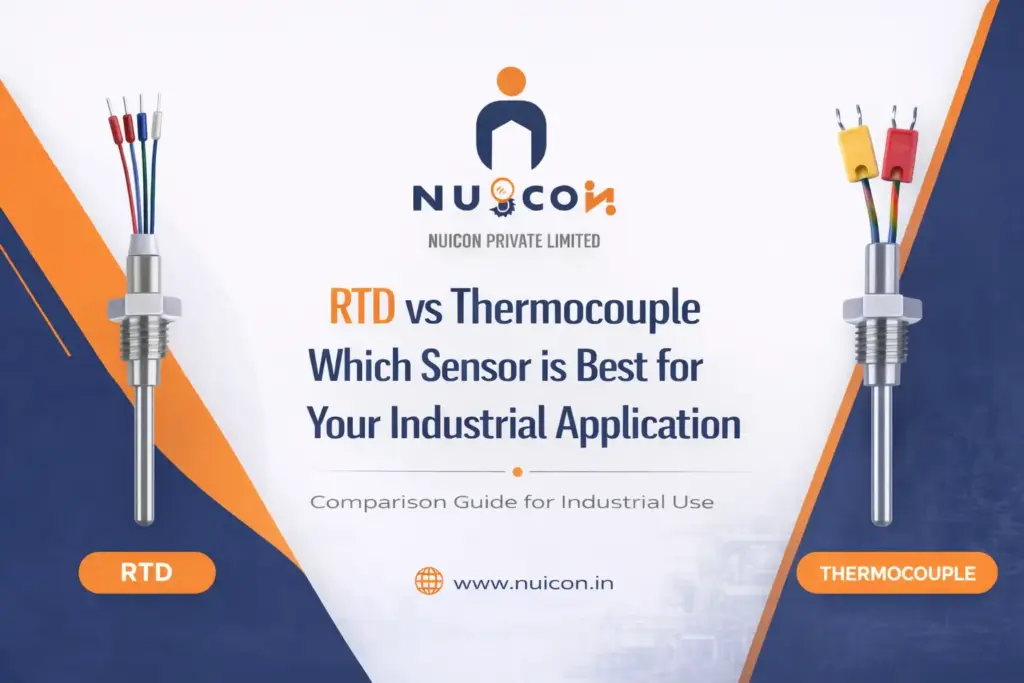
RTD vs Thermocouple: Which Sensor is Best for Your Industrial Application? The Quick Answer (For Busy Engineers – Plant Engineers, Facility Managers, OEMs.) If you need a fast decision on RTD vs Thermocouple, here is the rule of thumb: Select an RTD (Resistance Temperature Detector) if your priority is high accuracy and long-term stability within temperatures of -200°C to 850°C. They are the industry standard for Pharmaceuticals, Food & Beverage, and HVAC applications. Select a Thermocouple if your process involves extreme temperatures (up to 2300°C), heavy vibration, or requires a fast response time. They are the go-to choice for Steel, Cement Kilns, and Power Generation. Introduction: The Battle for Precision In industrial automation, temperature is the single most measured variable. Yet, selecting the right sensor remains one of the most common debates we hear from our clients at Nuicon. Choosing the wrong sensor isn’t just a technical detail—it impacts your bottom line. An incorrect choice can lead to energy wastage in boilers, inconsistent product quality in chemical batches, or frequent maintenance downtime. This guide provides a transparent, engineering-grade comparison of the RTD vs Thermocouple to help you make the right choice for your specific plant requirements in 2025. What is an RTD Sensor? An RTD (Resistance Temperature Detector) operates on a physical principle where the resistance of a metal increases as the temperature rises. Most industrial RTD sensors are constructed using high-purity Platinum. This is why you will often see them referred to as a Pt100 sensor (100 ohms at 0°C) or Pt1000. Platinum is chosen because it offers a highly linear and stable resistance-temperature relationship. Primary Benefit: exceptional repeatability and stability over time. Best For: Applications requiring precision control, such as a vaccine storage fridge or a milk pasteurization line. Nuicon Expert Tip: Because RTDs are sensitive, we often protect them with robust Thermowells to prevent physical damage from flow or pressure. What is a Thermocouple? A Thermocouple (TC) is a simpler, more rugged device. It consists of two dissimilar metal wires joined at one end, known as the “hot junction.” When this junction heats up, it generates a tiny voltage (millivolts) via the Seebeck Effect, which the controller reads as temperature. Unlike RTDs, thermocouple sensors are self-powered and do not require an external excitation current. Primary Benefit: Durability and wide temperature range. Common Types: Type J & K: Most common for general industrial use. Type R & S: Precious metals for very high heat. Best For: Harsh environments like blast furnaces, gas turbines, or engine exhausts. RTD vs Thermocouple: The Technical Comparison When designing an instrumentation system, comparing the specs side-by-side is critical. Here is how they stack up: Feature RTD (Resistance Temperature Detector) Thermocouple (TC) Temperature Range Moderate: -200°C to +850°C Extreme: -270°C to +2300°C Accuracy High: ±0.1°C (Class A) Lower: ±0.5°C to ±5.0°C Response Time Slower (2 to 10 seconds) Very Fast (Fraction of a second) Long-Term Drift Very Low (Stable for years) Higher (Needs frequent calibration) Vibration Handling Sensitive (Can fail under shock) Excellent (Handles high vibration) Cost Higher Initial Investment Lower Initial Cost Selection Guide: 4 Factors to Decide At Nuicon, we recommend evaluating these four factors before placing an order. A. Temperature Range This is your first filter. If your application exceeds 850°C—common in metal processing or brick manufacturing—an RTD will physically fail. In this range, a high-temperature thermocouple is your only option. B. Accuracy Requirements How tight is your tolerance? If a 1-degree shift affects your product quality (e.g., in a bio-reactor), the Pt100 sensor is the superior choice. Thermocouples have a wider “error margin” which might be unacceptable for precision chemistry. C. Response Time Does your temperature change rapidly? Because thermocouples measure at the tip (point contact), they react instantly. RTDs usually measure over a larger area (the element length), creating a slight lag. For plastic injection molding, where speed matters, go with a TC. D. Vibration and Environment If the installation point vibrates heavily (like a compressor or generator), the delicate wire construction of a standard RTD might break. A mineral-insulated thermocouple is built to withstand this abuse. Industry Use Cases: Where They Win Where RTD Wins: Pharmaceuticals: Precise temperature logging for compliance. Food & Beverage: Ensuring safety standards in brewing and dairy. HVAC Systems: Monitoring air ducts and chilled water lines for energy efficiency. Laboratories: Calibration standards and research. Where Thermocouple Wins: Steel & Cement: Kilns and ovens operating above 1000°C. Power Plants: Steam turbines and exhaust gas monitoring. Plastic Manufacturing: Extruders requiring fast thermal response. General OEM: Cost-effective sensors for simple machinery. Frequently Asked Questions (FAQs) Q: Can I replace a Thermocouple with an RTD? A: Not directly. Their electrical signals are different (Resistance vs. Voltage). To switch, you must ensure your temperature controller or PLC input card supports the new sensor type. Q: Why is the Pt100 the most common RTD? A: The Pt100 offers the best balance of linearity, cost, and stability. It has a resistance of 100 ohms at 0°C, making it a universal standard for industrial instrumentation. Q: How often should I calibrate my sensors? A: For critical industries like Pharma, we recommend sensor calibration every 6 to 12 months. Thermocouples generally drift faster than RTDs and may need more frequent checks. Conclusion: Precision or Durability? The debate of RTD vs Thermocouple isn’t about which technology is “better” overall—it is about which is better for your specific process. Need stability and precision? Choose an RTD. Need durability and high heat handling? Choose a Thermocouple. Nuicon manufactures both technologies in-house. Whether you need a custom-length Type K thermocouple or a sanitary Pt100 assembly, we deliver OEM-quality sensors tailored to your plant’s needs. Still unsure which sensor fits your machinery? Contact Nuicon’s Engineering Team today for a free consultation. Recent Posts RTD vs Thermocouple: Which Sensor is Best for Your Industrial Application September 19, 2025 RTD vs Thermocouple: Which Sensor is Best for Your Industrial Application? The Quick Answer (For Busy Engineers – Plant Engineers,… Read More →