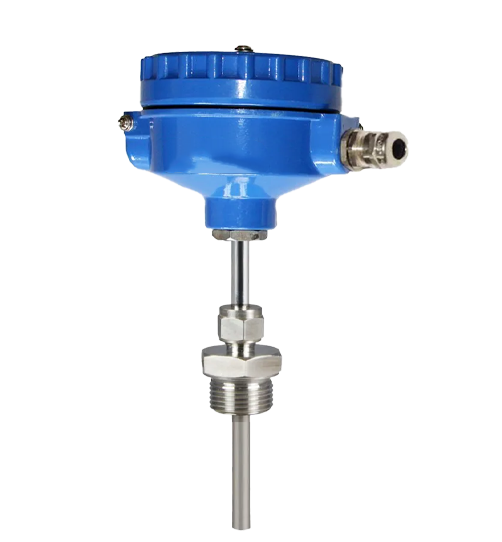
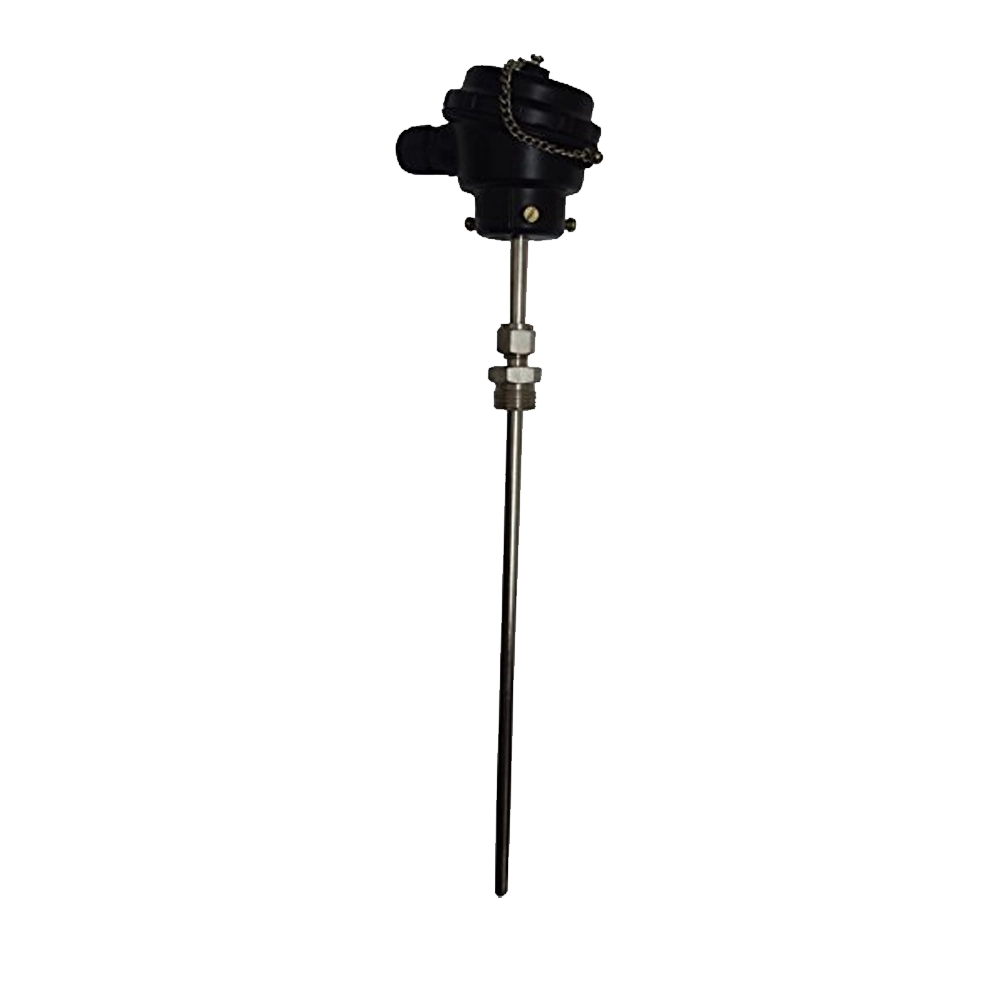
The Quick Answer: What is a Pt100 Sensor?
A Pt100 sensor is the most common type of resistance temperature detector (RTD) used in industry. The name tells you exactly what it is:
- “Pt” stands for platinum (the material used).
- “100” stands for 100 ohms (the resistance value at 0°C).
It is the global standard for applications requiring high temperature accuracy and stability between -200°C and +850°C. If your process needs precision better than 1°C, a Pt100 is likely your best choice.
1. Understanding the Working Principle
The working principle of a Pt100 is based on the relationship between metal and temperature. As the temperature of the platinum element increases, its resistance to electricity increases in a predictable, linear way.
Unlike thermocouples, which generate voltage, a Pt100 RTD is a passive device. To get a temperature reading, your controller or PLC sends a small electric current through the sensor to measure the resistance, then converts that resistance into a temperature display.
Because Platinum is chemically inert and stable, these sensors offer excellent repeatability, meaning they will read the same temperature consistently over many years without significant drift.
2. Pt100 Wiring Configurations (2, 3, and 4-Wire)
One of the most confusing aspects for technicians is the wiring. You will see Pt100s sold as 2-wire, 3-wire, or 4-wire models. The difference isn’t just about the number of cables—it is about accuracy.
A. 2-Wire Pt100 (Lowest Accuracy)
This is the simplest form. One wire connects to each end of the element.
- The Problem: The controller measures the resistance of the sensor plus the resistance of the lead wires. If your cables are long, this added resistance causes a “false high” temperature reading.
- Use Case: Only used for short distances or where high precision is not critical (e.g., simple HVAC).
B. 3-Wire Pt100 (The Industrial Standard)
This is the most common configuration in manufacturing. It adds a third wire to the circuit.
- The Solution: The controller uses the third wire to measure and subtract the resistance of the lead cables. This “compensation” removes the error caused by long cable runs.
- Use Case: Standard for process instrumentation in Pharma, Food, and Textiles.
C. 4-Wire Pt100 (Highest Accuracy)
This setup uses two wires to carry the current and two wires to measure the voltage drop across the sensor element.
- The Benefit: It eliminates all lead wire errors, regardless of cable length or quality.
- Use Case: Laboratory calibration standards and high-precision thermal mapping.
Nuicon Tech Note: For 90% of industrial applications, we recommend the 3-wire Pt100. It offers the perfect balance of cost and accuracy.
3. Accuracy Classes: Class A vs. Class B
All platinum resistance thermometers are not equal. Tolerance standards defined by IEC 60751 grade them:
- Class B: The standard industrial grade.
- Accuracy: ±0.30°C at 0°C.
- Best for: General monitoring (water tanks, ovens).
- Class A: The precision grade.
- Accuracy: ±0.15°C at 0°C.
- Best for: Critical control points (chemical reactors, milk pasteurization).
Nuicon manufactures both grades, but we always advise checking your process tolerance before choosing to avoid paying for unnecessary precision.
4. Why Choose a Pt100 Over Other Sensors?
While thermistors and thermocouples have their place, the Pt100 sensor dominates the market for three reasons:
- Linearity: The resistance change is very smooth across the temperature range, making it easy to calibrate.
- Stability: Platinum does not degrade quickly. A high-quality OEM sensor can last for years with minimal drift.
- Interchangeability: Since Pt100 is a global standard, you can swap a Nuicon Pt100 with any other brand’s controller without reprogramming the system.
Frequently Asked Questions (FAQs)
What is the difference between Pt100 and Pt1000?
A Pt100 has a resistance of 100Ω at 0°C, while a Pt1000 has 1000Ω. The Pt1000 is often used in battery-powered devices because its higher resistance requires less current, saving battery life.
How do I test if my Pt100 is working?
You can use a multimeter. At room temperature (approx 20-25°C), the resistance should read between 107Ω and 110Ω. If it reads infinite (open circuit) or zero (short circuit), the sensor is faulty.
Can I extend the cable of my Pt100?
Yes, but you must use a proper shielded instrumentation cable. If you are using a 2-wire sensor, extending the cable will reduce accuracy. We recommend using a temperature transmitter if the distance exceeds 50 meters.
Conclusion: The Backbone of Industrial Temperature Control
Whether you are managing a boiler in a textile mill or a cold storage unit in a pharma plant, the Pt100 sensor is likely the backbone of your control system. Its ability to provide reliable, precise data ensures your operations run safely and efficiently.
However, getting the right reading depends on selecting the right wiring configuration (2, 3, or 4-wire) and the correct accuracy class.
Nuicon specializes in manufacturing custom industrial sensors tailored to your specific cable lengths, sheath materials, and connection heads.
Need a replacement Pt100 or a custom assembly? Explore Nuicon’s Temperature Solutions or contact our team for a quote today.
Pt100 Sensor Guide: Wiring, Working Principle & Accuracy | Nuicon
What is a Pt100 sensor? Understand the working principle, the difference between 2, 3 & 4-wire configurations, and accuracy classes in this expert guide by Nuicon.